I’ve spent the last decade working as an emergency room nurse in Chicago, seeing things that would make most people’s stomachs turn, but absolutely nothing prepared me for the chilling secret hiding inside a dusty leather purse in my own grandmother’s house.
My grandmother, Eleanor, is eighty-four years old. She has lived in the same sprawling, creaky farmhouse in rural Pennsylvania since the late 1960s.
She is a tough, no-nonsense woman who raised three kids on her own after my grandfather passed away unexpectedly when I was just a baby.
Last month, her health took a sudden downturn. It wasn’t anything immediately life-threatening, but a bad fall on the porch stairs meant she couldn’t live alone in that massive house anymore.
We made the difficult decision to move her into a beautiful assisted living facility closer to where I live.
Because my parents were dealing with their own health issues down in Florida, it fell on me to take two weeks off from the hospital to pack up Eleanor’s life.
It was a daunting task. Fifty years of memories, hoarding, and history stuffed into every closet, basement corner, and crawlspace.
But I wasn’t entirely alone. I had Barnaby.
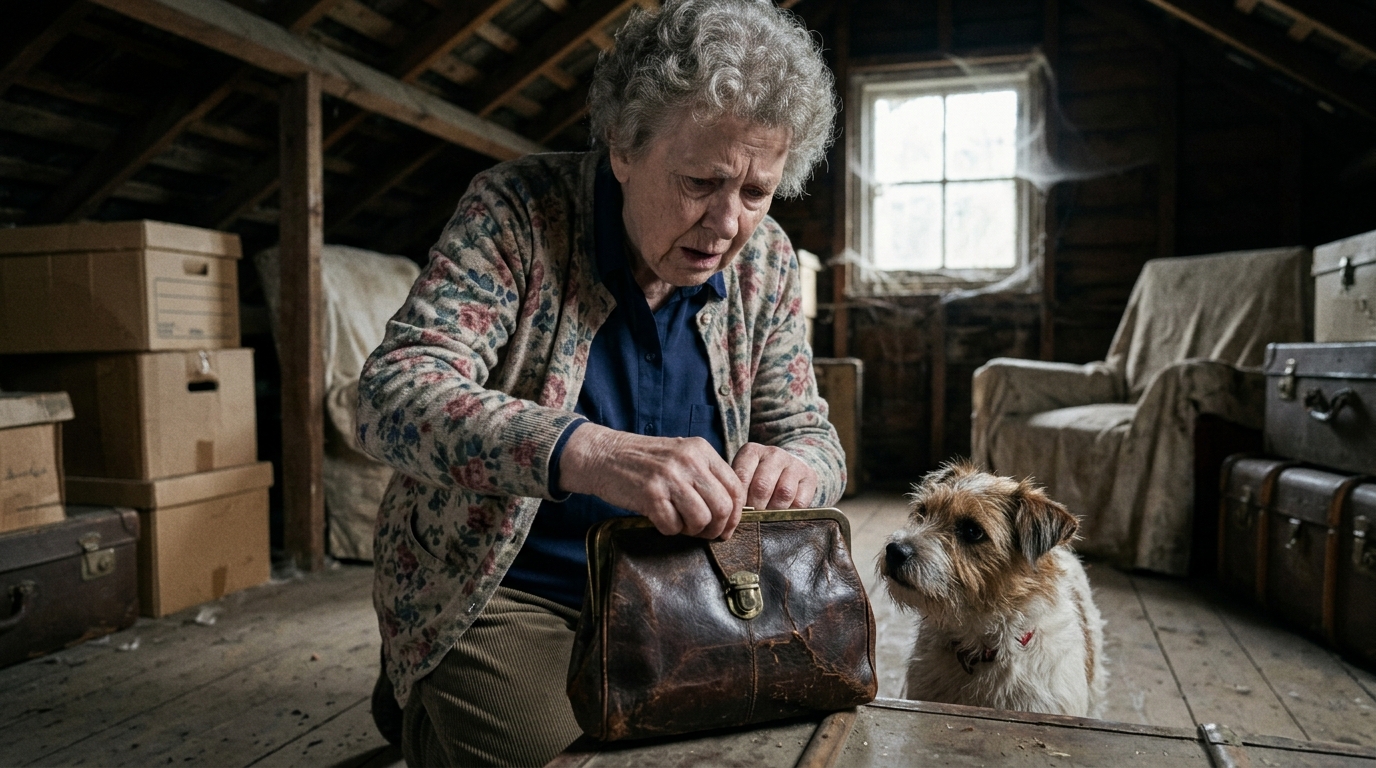
Barnaby is my grandmother’s Papillon. If you don’t know the breed, they are those tiny, delicate dogs with huge ears that look like butterfly wings.
Barnaby weighs maybe eight pounds soaking wet. He is practically a stuffed animal.
Usually, he spends his days sleeping on a velvet pillow by the radiator, eating expensive wet food, and demanding belly rubs from anyone who walks through the front door. He doesn’t have an aggressive bone in his tiny body.
Or so I thought.
On my third day at the farmhouse, I decided it was time to tackle the attic.
My grandmother had specifically told me to leave the attic alone. She claimed there was nothing up there but old Christmas decorations and moth-eaten coats that needed to be thrown out anyway.
“Don’t waste your time up in that dust trap, Sarah,” she had said from her armchair downstairs, her voice tight. “The junk removal guys can just toss it all.”
But knowing how much a junk removal company charges by the pound, I figured I could at least sort through the obvious garbage to save us some money.
I pulled the creaky attic stairs down from the hallway ceiling. The hinges screamed in protest.
Barnaby, who usually hated stairs, suddenly trotted over. He looked up at the dark, square opening with an intense, unblinking stare.
“Come on, buddy,” I muttered, grabbing a flashlight and a roll of trash bags. “Let’s go see what kind of mess we’re dealing with.”
The attic smelled exactly how you would expect: old wood, dead spiders, and decades of stagnant, trapped air.
I clicked on the single bare bulb hanging from the rafters. It cast long, creepy shadows across piles of cardboard boxes and old furniture covered in white sheets.
I started in the corner nearest the stairs, tossing old holiday wreaths and broken lamps into my heavy-duty trash bag.
For the first hour, everything was normal. I was coughing on the dust, but making good progress.
Then, I heard a low, rumbling sound.
It sounded like a small engine starting up. I paused, wiping sweat from my forehead, and turned around.
It was Barnaby.
He was standing in the far back corner of the attic, tucked behind an ancient, rotting wooden dresser.
His posture was completely unrecognizable. His tiny body was stiff, his hackles were raised, and his teeth were fully bared.
He was staring down at the floor boards, emitting a continuous, vibrating growl that sent a cold shiver straight down my spine.
“Barnaby?” I called out, my voice sounding too loud in the quiet space. “What’s wrong, boy? You find a mouse?”
I walked toward him, shining my flashlight into the dark corner.
As the beam of light hit the floor, I saw it.
It wasn’t a mouse. It wasn’t a dead animal.
It was a purse.
It was a heavy, dark brown leather purse with a tarnished, heavy brass clasp. It looked incredibly out of place. It wasn’t inside a box or a trunk. It was just sitting there on the bare floorboards, wedged into the tightest, darkest corner of the room, completely covered in a thick layer of gray dust.
It looked like it had been hidden. Pushed back there on purpose.
I reached my hand out to pick it up.
The moment I moved my arm, Barnaby snapped.
He lunged forward, snapping his jaws violently just inches from my fingers. His bark was sharp and deafening in the enclosed space.
I yanked my hand back in shock, tripping over my own feet and landing hard on my tailbone.
“Barnaby! Stop!” I yelled, my heart hammering against my ribs.
He didn’t look at me. He just stepped directly on top of the old leather purse, planting his tiny paws firmly on the cracked leather.
He looked at me with wild, bloodshot eyes, daring me to try again.
I was completely dumbfounded. This was a dog that got scared of his own shadow. Now he was acting like a trained guard dog protecting a million dollars in cash.
“Fine,” I muttered, backing away slowly. “Keep the creepy trash. I’ll get it later.”
I went downstairs, told my grandmother the attic was too dusty, and spent the rest of the afternoon packing up the kitchen. I assumed Barnaby would get bored, get hungry, and come down for his dinner.
He didn’t.
Night one passed. When I woke up the next morning, Barnaby’s food bowl was untouched.
I climbed halfway up the attic stairs. He was still there. In the exact same spot. Standing over the purse.
I tried bringing him a piece of hot dog. He ignored it. When I took one step toward the purse, he bared his teeth and let out that demonic growl again.
This behavior continued for two full days.
By night three, I was genuinely getting scared. The dog hadn’t eaten or drank water in over forty-eight hours. He was going to die of dehydration if I didn’t intervene.
I tried to grab him with a thick winter blanket, thinking I could safely scoop him up.
It was a disaster. He fought like a wild animal, tearing a hole in the blanket and almost getting my wrist. I had to retreat again, locking the attic door so he couldn’t bring whatever disease he suddenly had downstairs.
On the fourth day, my grandmother started asking questions.
“Where is Barnaby?” she asked from her bed, looking frail and tired. “He hasn’t slept next to me in days.”
I bit my lip. “He’s… he’s up in the attic, Grandma. He found an old purse behind a dresser and he won’t let anyone near it. He’s acting crazy.”
The moment the word ‘purse’ left my mouth, the room temperature seemed to drop ten degrees.
My grandmother’s eyes widened. She slowly sat up, her breathing suddenly shallow and rapid.
“What kind of purse?” she whispered, her voice trembling.
“It’s just an old, dark brown leather one. Heavy brass clasp,” I replied, suddenly feeling a knot form in my stomach. “Grandma, what’s wrong?”
She didn’t answer me. She threw her blanket off and forced herself out of bed.
“Grandma, you shouldn’t be walking—”
“Help me upstairs,” she commanded. It wasn’t a request. It was an order from a woman who sounded completely terrified.
I supported her weight as we made the slow, painful journey down the hall and up the creaky attic stairs.
When we reached the top, the air felt suffocating.
Barnaby was still there. He looked incredibly weak, his tiny legs shaking from exhaustion, but his eyes were still locked onto the entrance.
When he saw my grandmother, his reaction changed.
He didn’t growl. He didn’t bare his teeth.
He let out a long, pitiful whimper, stepped off the purse, and collapsed onto his side on the dusty floorboards. It was as if his mission was finally over. He had guarded it until the right person arrived.
My grandmother let go of my arm.
She walked toward the corner like a woman walking to her own execution. Her breathing was ragged.
“Grandma, please, let’s just throw it away. You don’t need to look at it,” I pleaded, feeling a profound sense of dread washing over me.
“Step back, Sarah,” she whispered, her voice cracking.
She knelt down on the hard floor, wincing in pain. She reached out.
I watched as her fingers brushed the thick dust off the leather.
She grasped the heavy brass clasp.
The silence in the attic was deafening. Even Barnaby was completely quiet, his chest barely rising and falling.
Click.
The heavy metal clasp snapped open.
My grandmother slowly pulled the flaps of the leather purse apart and looked inside.
I couldn’t see what was in there from where I was standing.
But I saw her reaction.
All the color instantly drained from her face. Her skin turned a sickly, ash-gray.
Her mouth opened in a silent scream, and her hands began to shake.
It wasn’t just a slight tremor. Her hands were violently, uncontrollably shaking, vibrating so hard that the heavy purse dropped from her grip and hit the floorboards with a dull, heavy thud.
She looked up at me, tears streaming down her deeply wrinkled face, her eyes filled with a terror I had never seen in a human being before.
And then she said three words that completely shattered my reality.
“He never died.”
Those three words hung in the stale, heavy air of the attic, echoing in the suffocating silence.
I froze. My brain, trained to process trauma and chaos in a fraction of a second in the emergency room, suddenly short-circuited.
I looked at my grandmother. She was still on her knees, her frail body trembling so violently that I could hear her joints popping. The heavy, dark brown leather purse lay completely upside down on the dusty wooden floorboards between us.
When it had hit the ground, the ancient brass clasp had finally given way completely.
The contents had spilled out onto the gray, dust-caked wood.
For a terrifying five seconds, neither of us moved. Barnaby, the tiny Papillon who had guarded this spot like a soldier on the front lines for almost a week, let out a soft, rattling sigh and closed his eyes, his chin resting flat against the floorboards.
My medical training finally kicked in, overriding my paralyzing shock.
I dropped to my knees beside her. Eleanor’s skin was no longer just pale; it had taken on a terrifying, translucent blue hue around her lips. Her chest was heaving in short, jagged gasps, but she wasn’t pulling in enough oxygen.
She was going into a full-blown panic attack, and at eighty-four years old, her heart simply could not handle the strain.
“Grandma, look at me,” I commanded, my voice dropping into the calm, authoritative tone I used with coding patients back in Chicago.
She didn’t look at me. Her wide, terrified eyes were locked dead onto the pile of objects that had fallen from the purse.
I grabbed her shoulders firmly, forcing her to break her gaze. “Eleanor! Look at my eyes. Right now.”
She blinked, her head snapping toward me. Tears were cutting deep tracks through the dust on her wrinkled cheeks.
“Breathe with me. In through your nose. Out through your mouth. Do it now.”
I grabbed her icy, shaking hands and pressed them flat against my own chest so she could feel the slow, exaggerated rhythm of my breathing.
It took two agonizingly long minutes. In the ER, two minutes of a cardiac event feels like an eternity. Up in that sweltering, claustrophobic attic, it felt like a lifetime.
Slowly, the bluish tint started to fade from her lips. Her breathing leveled out into ragged, exhausted sighs. Her entire body suddenly went limp, and I had to catch her under the arms to keep her from collapsing completely onto the hard floor.
“Okay,” I whispered, keeping one arm tightly wrapped around her frail waist. “Okay. You’re okay. I’ve got you.”
She shook her head, her thin white hair clinging to her damp forehead.
“I’m not,” she rasped, her voice sounding like dry leaves crushing under a boot. “We’re not. Sarah… look.”
She raised a trembling finger and pointed at the mess on the floorboards.
I hadn’t let myself look yet. I had purposely kept my focus on my grandmother’s vitals. But now, with her somewhat stabilized, I turned my head.
There were no bundles of cash. There were no stolen jewels. There were no old love letters wrapped in romantic ribbons.
The items that had tumbled out of that heavy leather purse were disjointed, bizarre, and deeply unsettling.
First, there was a stack of old, faded Polaroid photographs. They were tightly bound together by a thick, hardened rubber band that had begun to rot and melt into the paper.
Next to the photos was a heavy, rusted iron padlock. It wasn’t a standard lock; it was massive, the kind you would see on the heavy steel doors of an old prison or an industrial freezer.
And finally, scattered across the dust like morbid confetti, were dozens of small, tarnished metal discs.
I leaned forward, my heart hammering against my ribs, and squinted in the dim light of the single bulb hanging above us.
They were dog tags.
But they weren’t military tags. They were rabies vaccination tags and county dog license tags. Dozens and dozens of them. Some were silver, some were brass, some were shaped like tiny bones or fire hydrants. They were deeply scratched and tarnished with decades of age.
And they were all stained with something dark, rusty, and brown.
Blood.
My breath caught in my throat. I looked over at Barnaby. The tiny dog was still lying there, completely exhausted. It suddenly made a horrifying kind of sense. Dogs have an incredible sense of smell. Barnaby hadn’t been guarding a piece of trash. He had smelled the blood. He had smelled the metallic, lingering scent of dozens of unknown dogs hidden in the dark.
He was protecting us from whatever violence this purse represented.
“Grandma,” I started, my voice shaking despite my best efforts to stay clinical. “What is this? Whose purse is this?”
She let out a dry, broken sob.
“It wasn’t a purse, Sarah,” she whispered, her eyes dark and hollow. “It was his work bag. It belonged to your grandfather.”
I stared at her, completely uncomprehending.
My grandfather, Arthur, was a legend in our family. I had never met him—he died in a tragic, fiery car crash on a wet Pennsylvania highway when I was just six months old. But I had grown up surrounded by his legacy.
He was a hero. That was the story I had been fed since I could comprehend language.
Arthur had been a pillar of the community in the 1960s and 70s. He ran a local contracting business, but his real passion, according to the family lore, was animal rescue. He supposedly spent all his free time and extra money driving around rural counties, picking up stray, abandoned, and abused dogs, and finding them new homes.
My mother used to tell me stories about how he would come home covered in mud and dog hair, carrying a shivering puppy in his heavy coat. He was practically a saint.
“What do you mean?” I asked, my voice rising in pitch. “Grandpa Arthur? The man who rescued all those animals? Why would he have a purse full of bloody dog collars in the attic?”
Eleanor squeezed her eyes shut. The pain on her face was so raw, so visceral, that I had to look away for a second.
“He didn’t rescue them, Sarah,” she said, her voice dropping to a dead, emotionless monotone that terrified me more than her screaming would have. “He didn’t rescue anyone.”
She pulled her hands away from mine and slowly, painfully reached out toward the pile of scattered items.
Her shaking fingers bypassed the bloody tags and the heavy iron lock. She went straight for the rotting stack of Polaroid photographs.
She picked them up. The old, dried rubber band snapped with a sharp crack, turning to dust and raining down onto the floor.
The photos fanned out in her hand.
“Your grandfather was a very sick man,” Eleanor continued, staring at the top photograph. “A very smart, very charming, but deeply sick man. And I… I helped him hide it. For fifty years, I helped him hide it.”
“Hide what?” I demanded. The emergency room nurse in me was gone. I was just a terrified granddaughter kneeling in a filthy attic, feeling the foundation of my entire life cracking beneath me.
She turned the top photograph around so I could see it in the dim, yellow light.
It was a picture of a young Arthur. He looked handsome, wearing a thick flannel shirt, his dark hair slicked back. He was smiling warmly at the camera.
But it wasn’t a portrait. He was standing in front of something.
I leaned in closer, brushing a thick cobweb away from my face.
Behind my grandfather in the photograph was a massive, concrete structure. It looked like an old, abandoned bunker or a heavy industrial cellar. The heavy steel door was chained shut.
And standing right next to him in the photograph, holding his hand, was a woman.
She looked to be in her early twenties. She was beautiful, but her face was gaunt, her eyes sunken and hollow. She was wearing a tattered hospital gown.
“Who is that?” I asked, a cold sweat breaking out on the back of my neck.
“That,” Eleanor whispered, “is your real grandmother.”
The silence returned, heavier and darker than before.
“What?” I choked out. “Grandma, what are you talking about? You’re my grandmother. You gave birth to my mother.”
Eleanor shook her head slowly.
“No, Sarah. I didn’t. I couldn’t have children. Your grandfather knew that when he married me. He told me it didn’t matter. He told me we would build a life anyway.”
She flipped to the next photograph.
It was a picture of the same young woman in the hospital gown. But this time, she was sitting on a dirty mattress inside what looked like that concrete bunker. The heavy iron padlock that was currently resting on the attic floorboards was clearly visible in the photo, locking a heavy metal gate from the outside.
The woman was holding a newborn baby wrapped in a filthy, dark brown blanket.
“He wanted a family,” Eleanor said, her voice completely detached now, as if she were reading from a history textbook. “And Arthur always got exactly what he wanted. He found her wandering on the highway near the old state psychiatric hospital. She had escaped. She was sick. Nobody was looking for her.”
My stomach lurched violently. I clamped a hand over my mouth, fighting the sudden, overwhelming urge to vomit.
“He locked her down there?” I gasped, the reality of the images finally snapping into place. “In a bunker?”
“It was an old root cellar on the edge of the property,” Eleanor replied flatly. “He reinforced it. Soundproofed it. He told everyone he was building a specialized kennel for his… rescue dogs. That’s why no one ever questioned the noise. When people heard crying or screaming coming from the woods, he just smiled his charming smile and said it was a traumatized rescue dog that was having a tough night.”
I looked down at the dozens of bloody metal dog tags scattered on the floor.
“The dogs,” I whispered, the puzzle pieces clicking together to form a picture of pure, unadulterated evil. “There were no rescues.”
“No,” Eleanor confirmed, a tear finally dropping onto the cracked leather of the empty purse. “He used the stray dogs as a cover. He collected their tags to make it look official if the county ever came asking. And he used them to mask the scent.”
“The scent of what?” I asked, though I already knew the answer.
“The scent of death, Sarah,” she replied.
I couldn’t breathe. The air in the attic felt like poison. I looked at the woman sitting next to me—the woman who had baked me cookies, who had stitched my torn dresses, who had held my hand when I graduated from nursing school.
“You knew,” I said, stepping back from her, my voice laced with a sudden, overwhelming disgust. “You lived in this house. You knew he had a woman locked in a cage on the property, and you did nothing?”
Eleanor didn’t flinch at my tone. She simply looked at the photograph of the woman holding the baby.
“I was terrified of him,” she whispered. “You don’t understand what it was like. He would have put me down there with her. Or worse. And then…”
She traced her finger gently over the face of the newborn baby in the Polaroid.
“And then, he brought the baby into the house. He handed her to me. He told me that she was ours now. That I was finally a mother.”
My mother.
The woman in the picture was my biological grandmother, and the baby wrapped in the filthy blanket was my mother.
My mind was spinning so fast I felt dizzy. “What happened to her?” I demanded, pointing at the woman in the photo. “What happened to my real grandmother?”
Eleanor slowly lowered the photographs into her lap. She looked past me, staring into the dark, dusty recesses of the attic roof.
“When your mother was three months old, the woman started getting violent. She was trying to break the door down. Arthur said she was a liability. He told me he took her back to the psychiatric hospital.”
“And did he?” I pressed, my heart pounding in my ears.
Eleanor finally turned to look at me, and the expression on her face made my blood run freezing cold.
“That’s why I brought you up here, Sarah,” she whispered. “That’s why Barnaby wouldn’t let you near this bag.”
She reached out and picked up the heavy, rusted iron padlock.
“When the police told me Arthur died in that car fire fifty years ago, I believed them. I wanted to believe them. I buried an empty casket and I raised your mother as my own.”
She turned the massive iron padlock over in her hands.
“But last week, right before I fell on the porch… I saw him.”
“Saw who?” I asked, my voice barely a squeak.
“Arthur,” she breathed. “He was standing at the edge of the tree line. Watching the house.”
She dropped the heavy lock back onto the wooden floorboards with a sickening thud.
“And he wasn’t alone.”
“He wasn’t alone.”
Those four words slammed into me with the force of a physical blow. The suffocating heat of the attic suddenly vanished, replaced by an ice-cold chill that radiated from the marrow of my bones outward.
I stared at my grandmother, Eleanor, desperately searching her deeply lined face for any sign of dementia, any hint that the bad fall she took last week had somehow caused a slow brain bleed, creating a terrible, vivid hallucination.
In the emergency room, we see it all the time. Geriatric patients come in with a urinary tract infection or a minor concussion, and suddenly they are seeing demons in the corners of their hospital rooms. I wanted it to be that. I needed it to be that.
“Grandma,” I started, keeping my voice steady and measured, the exact tone I used to de-escalate psychiatric patients. “You had a severe fall on the porch. You hit your head. Your mind is playing tricks on you. Grandpa Arthur died in 1974. There was a police report. A funeral. A casket.”
Eleanor let out a bitter, dry laugh that sounded like sandpaper scraping against stone. It wasn’t the laugh of a confused old woman. It was the laugh of someone who had spent half a century living with a ghost, only to have that ghost finally knock on the front door.
“An empty casket, Sarah,” she corrected me, her eyes locking onto mine with terrifying lucidity. “I told you. I buried an empty casket. The police said the fire in the car was so hot, so completely consuming, that there were only fragments left. Dental records matched. That’s what they told me.”
She leaned closer, her frail hands gripping my forearms with a strength that shocked me. Her fingernails dug painfully into my skin.
“But Arthur was a general contractor,” she whispered, her voice trembling but fiercely urgent. “He hired drifters. Men off the highway who needed cash under the table. Men with no families. No fixed addresses. Nobody looking for them. If he wanted to disappear, he had all the materials he needed. Including a body.”
My breath hitched. The clinical, rational part of my brain fought violently against the terrifying logic of her words.
“But why?” I pleaded, looking desperately at the bloody dog tags scattered across the dusty floorboards. “Why would he fake his own death?”
“Because the woman in the cellar escaped again,” Eleanor said flatly, pointing a trembling finger at the faded Polaroid photograph of my biological grandmother. “She broke the padlock. The police were starting to ask questions about the noises. The county was coming to inspect his ‘kennels’. The net was closing in. So he set a fire, put a ring I bought him on a dead man’s finger, and vanished.”
I looked down at Barnaby. The tiny Papillon was still lying flat on his side, his ribs expanding and contracting in quick, shallow breaths. He let out a soft whine, his large, bat-like ears twitching nervously.
“Okay,” I said, my heart hammering a frantic rhythm against my ribs. “Okay, let’s say you’re right. Let’s say he survived. That was fifty years ago. He would be in his late eighties now. Why would he come back now?”
Eleanor’s eyes filled with fresh tears, spilling over her wrinkled cheeks and dripping onto the collar of her nightgown.
“Because he knows you’re here, Sarah,” she choked out. “He knows I’m getting weak. He knows I’m leaving this house. And he knows what is hidden in this attic. He couldn’t take his work bag with him when he fled. It was too risky. He left it here, buried in the darkest corner, assuming I would never find it. Or that I would be too terrified to ever look.”
She took a ragged, desperate breath.
“When I told you I saw him at the tree line last week… he was just standing there. In the pouring rain. Staring at my bedroom window. He looked ancient, Sarah. His hair was completely white, his shoulders were hunched, but it was him. I felt it in my soul. I felt the evil.”
“And you said he wasn’t alone,” I prompted, dreading the answer. “Who was with him?”
Eleanor swallowed hard, her eyes darting nervously toward the small, dirty attic window at the far end of the room.
“Dogs,” she whispered. “Three massive, pitch-black dogs. They didn’t bark. They didn’t move. They just stood perfectly still at his side, staring at the house with him.”
A wave of profound nausea washed over me. I remembered my mother’s stories of Arthur’s “rescues.” His unnatural control over animals.
“Grandma, how did you fall on the porch stairs?” I asked, a new, horrifying theory forming in my mind.
Eleanor closed her eyes. “I went out to lock the gate. I heard a rustling under the lattice. I bent down to look. I didn’t trip, Sarah. One of those massive black dogs lunged from the shadows. It slammed its heavy paws into my chest and threw me backward down the wooden steps.”
My blood ran cold. The fall hadn’t been an accident. It was an attack. A warning.
All of my medical training, all of my emergency room protocols, suddenly evaporated. There was no protocol for this. We were completely isolated in a creaky, massive farmhouse in rural Pennsylvania, miles away from the nearest neighbor, with an eighty-four-year-old woman with a failing heart, a severely dehydrated tiny dog, and a fifty-year-old secret wrapped in bloody leather.
Fight or flight. Those were the only two options left. And fighting a man who collected dog tags like trophies wasn’t an option.
“We are leaving,” I stated. My voice was suddenly hard, stripped of any comforting bedside manner. “We are leaving right now. We aren’t packing bags. We aren’t locking the doors. We are walking down those stairs, getting into my car, and driving straight to the police station in town.”
Eleanor looked up at me, a flicker of hope breaking through the absolute terror in her eyes. “You believe me?”
“I believe that we are in danger,” I said, grabbing her gently by the elbows and hauling her to her feet. “And I believe I’m not spending another second in this house.”
I stripped off my light cardigan and wrapped it tightly around Barnaby’s limp, tiny body. He barely resisted as I scooped him up. He felt completely weightless, a bundle of fragile bones and fur. I tucked him securely under my left arm, pressing him against my ribs.
“Lean on me,” I told Eleanor, wrapping my right arm around her waist. “We’re going down the stairs. Slow and steady.”
We navigated the steep, narrow attic stairs in agonizingly slow motion. Every creak of the old wooden floorboards sounded like a gunshot in the oppressive silence of the house.
When we finally reached the second-floor landing, the air felt cooler, but the atmosphere was suffocating. The farmhouse, a place I had always associated with warm holiday dinners and the smell of cinnamon apples, now felt like a giant, wooden cage. Every shadow seemed to stretch and twist. Every closed door felt like a threat.
“My purse is in the kitchen,” I whispered, keeping my voice barely above a breath. “The car keys are inside. We just need to get down the main staircase, through the living room, into the kitchen, and out the back door to the driveway.”
Eleanor nodded weakly. Her skin was still alarmingly pale, and a fine sheen of cold sweat coated her forehead. She was running purely on adrenaline, and at her age, that fuel supply was dangerously limited.
We started down the grand, sweeping staircase that led to the main foyer.
Ten steps.
Nine steps.
Eight steps.
We were halfway down when the house plunged into absolute, pitch-black darkness.
The low hum of the refrigerator in the kitchen instantly died. The soft, ambient glow of the digital clock in the hallway vanished.
Eleanor let out a sharp gasp, her fingers digging viciously into my arm. “Sarah!”
“Shh!” I hissed, freezing in place on the stairs.
I strained my ears, listening intently. It was a clear, windless afternoon outside, though the heavy curtains in the house were drawn shut. There was no storm. There was no lightning.
The power hadn’t failed. It had been cut.
My heart began to beat so fast and so hard that it physically hurt my chest. The blood rushed in my ears, creating a deafening static.
“Someone is at the breaker box,” Eleanor whispered, her entire body shaking uncontrollably against mine. “The breaker box is on the exterior wall of the kitchen.”
He was here.
After fifty years of hiding, after a week of watching from the tree line, Arthur had made his move. He knew we had gone into the attic. He knew the heavy brass clasp of the old leather purse had been opened. He knew his legacy of blood had been unearthed.
“Keep moving,” I breathed, my voice trembling despite my best efforts to sound brave. “We have the advantage of knowing the layout of the house. We just need to get to the car.”
We reached the bottom of the stairs and stepped onto the hardwood floor of the foyer. The living room stretched out before us, a vast sea of dark, imposing furniture.
I carefully shifted Barnaby’s weight under my arm. He was shivering violently, his tiny nose twitching in the dark.
We moved silently through the living room, navigating by memory. I kept one hand outstretched in front of me, my fingertips lightly brushing the back of the velvet sofa, then the edge of the antique coffee table.
As we approached the swinging door that led to the kitchen, a smell hit me.
It wasn’t the smell of old wood or dust. It was sharp, pungent, and deeply metallic.
It was the smell of wet, dirty fur.
Barnaby let out a sudden, sharp whine from inside my cardigan. It wasn’t his fierce, protective growl from the attic. It was a sound of pure, unadulterated terror.
I clamped my hand gently over his small muzzle, praying he wouldn’t bark.
I pushed the swinging kitchen door open a fraction of an inch.
The kitchen was shrouded in shadows, lit only by a tiny, sliver of gray afternoon light filtering through the crack in the heavy window blinds above the sink.
My eyes darted immediately to the kitchen island, where I had left my purse. It was still there.
But it wasn’t alone.
Standing right beside the island, perfectly silhouetted against the dim light from the window, was a massive, hulking shape.
It wasn’t a man.
It was a dog.
It was easily the size of a small wolf, its thick, wiry fur matted and pitch black. It stood perfectly still, its heavy head lowered, its ears pinned back. It wasn’t moving, and horribly, it wasn’t making a single sound. No growling. No panting. Just a silent, statuesque monster waiting in the dark.
My breath caught in my throat. I squeezed my eyes shut, praying my mind was playing tricks on me, projecting my grandmother’s terrifying stories into reality.
I opened my eyes. The dog was still there.
And then, I noticed the back door.
The heavy, solid oak door that led to the driveway was standing wide open. The deadbolt had been completely shattered, the wooden frame splintered inward.
Through the open doorway, I could see the hood of my silver sedan parked in the driveway.
We were twenty feet away from safety. Twenty feet of dark kitchen floor, guarded by a beast from hell.
Eleanor peeked over my shoulder through the crack in the door. She let out a muffled whimper, her hand flying to her mouth.
“It’s one of them,” she breathed into my ear. “It’s his.”
“Where is he?” I whispered back, my eyes scanning the dark corners of the kitchen.
If the dog was here, Arthur had to be close by.
Suddenly, a heavy, deliberate footstep echoed from the hallway directly behind us.
Not in the kitchen. In the house.
He was already inside.
He had let the dog into the kitchen to block the exit, and he had circled around to the front. We were trapped between a monster and a ghost.
Another footstep. Heavy. Slow. The sound of a heavy leather boot pressing onto the hardwood floor of the foyer.
Creak.
“Hello, Eleanor,” a voice called out from the darkness.
The sound of that voice sent a shockwave of pure horror through my entire nervous system. It was raspy, deep, and thick with decades of age, but it carried an undeniable, charming arrogance. It was the voice of a man who was entirely used to being in control.
Eleanor’s knees finally buckled. If I hadn’t been holding her up, she would have collapsed onto the floor.
“Arthur,” she sobbed softly, a pathetic, broken sound.
“It’s been a long time, my love,” the voice echoed through the dark house. The footsteps were getting closer. He was walking through the living room now. “I see you finally found my old things up in the rafters. I told you never to go up there.”
I pulled Eleanor backward, letting the swinging kitchen door gently close shut.
We were trapped in the narrow dining room that connected the kitchen and the living room.
“Think, Sarah, think,” I muttered frantically to myself, my mind racing through triage protocols, searching desperately for a solution.
We couldn’t go back upstairs. We couldn’t go out the front. We couldn’t go out the back.
“He’s going to kill us, Sarah,” Eleanor whispered, her eyes wide and blank with shock. “Just like he killed the others.”
“No,” I hissed fiercely. I looked around the dark dining room. My eyes landed on the heavy, antique silver candelabra sitting in the center of the mahogany dining table. It weighed easily ten pounds.
It wasn’t a great weapon, but it was all I had.
I gently set Barnaby down on the floor, pushing him under the heavy drape of the tablecloth. “Stay,” I whispered to the terrified tiny dog.
I guided Eleanor behind the heavy oak hutch in the corner, pressing her frail body against the wall.
“Do not move. Do not make a sound,” I commanded.
I stepped up to the dining table and wrapped both of my hands around the thick stem of the silver candelabra. I lifted it, the heavy metal cold and solid against my sweaty palms.
The footsteps stopped directly on the other side of the dining room archway.
I stood in the darkness, holding my breath, my muscles coiled tight like a spring.
A shadow fell across the archway. A tall, broad-shouldered figure stepped into the dim light.
He was holding something long and heavy in his right hand.
It looked exactly like the rusted iron padlock we had found in the attic. Only this one was attached to a thick, heavy metal chain.
He stopped, his head slowly turning toward the dark corner where I stood waiting.
And then, he smiled.
That smile will haunt my nightmares until the day I die.
It wasn’t the smile of an eighty-year-old man who had come to visit his family. It was the calculated, hollow grin of a predator that had finally cornered its prey after a very long hunt.
Even in the dim, shadowed light of the dining room, I could see the resemblance. He had my mother’s jawline. He had my eyes. The realization that I shared DNA with the monster standing in the archway made my skin crawl with violent disgust.
He was old, yes. His hair was sparse and stark white, his face mapped with deep, leathery wrinkles. But he wasn’t frail. He had the thick, broad build of a man who had spent his entire life doing manual labor, and the heavy iron padlock attached to the thick metal chain dangled from his massive hand effortlessly.
“You must be Sarah,” he said, his voice a low, gravelly purr that vibrated in the quiet room. “You know, I always wondered what happened to the baby. Eleanor did a passable job, I suppose. You grew up strong.”
I didn’t speak. I tightened my grip on the heavy silver candelabra, the sharp edges of the metal base digging painfully into my palms. I shifted my weight, planting my feet firmly on the hardwood floor, instinctively falling into a defensive stance.
In the emergency room, I dealt with violent, intoxicated, and psychotic patients on a weekly basis. I had been swung at, spat on, and pinned against walls. I knew how to read the physical cues of impending violence.
Arthur’s shoulders were dropped. His weight was balanced. He wasn’t here to talk.
“Where is she, Sarah?” he asked, taking one slow, deliberate step into the dining room. The metal chain clinked softly against his leg. “Where is my wife?”
“She’s gone,” I lied, my voice remarkably steady. “I called the police before the power went out. They’re already on their way.”
Arthur let out a soft, amused chuckle. He didn’t believe me for a second.
“The phone lines were cut an hour ago, sweetheart,” he said, taking another step. He was ten feet away now. “And you wouldn’t leave Eleanor behind. She’s too slow. She’s too weak. She’s right here in this room.”
He stopped, his dark eyes slowly scanning the shadows. He looked at the heavy dining table. He looked at the heavy oak hutch where Eleanor was pressed flat against the wall, paralyzed by terror.
“I don’t want to hurt you, Sarah,” Arthur lied, his voice dripping with a sickening, faux-paternal warmth. “You are my blood. You are my legacy. I just want my bag. And I want to tie up some loose ends with Eleanor. Fifty years is a long time to keep a secret. It takes a toll on a marriage.”
He raised his right arm, slowly swinging the heavy iron padlock in a tight, lazy circle. The chain whirred softly in the air.
“Give me the bag,” he demanded, his voice suddenly dropping its charming facade, replaced by a cold, hard edge.
“The bag is upstairs,” I said, my heart hammering a frantic, terrifying rhythm against my ribs. “Go get it yourself.”
His eyes locked onto mine. The amusement vanished.
“Wrong answer,” he snarled.
He lunged.
Despite his age, he moved with terrifying speed. He swung his arm in a brutal, wide arc, whipping the heavy iron padlock directly at my head.
My reflexes, honed by years of dodging sudden blows in the trauma ward, kicked in. I ducked hard, dropping to one knee.
The heavy iron lock sailed mere inches over my scalp, smashing into the mahogany dining table with a deafening, splintering crash. Wood shards exploded into the air, raining down on the floorboards.
Before he could pull the chain back to strike again, I exploded upward.
I didn’t aim for his head. I aimed for the center of mass. I gripped the thick stem of the silver candelabra with both hands and drove the heavy, flat base directly into the center of his chest with every single ounce of strength I possessed.
The impact was sickening. I felt the awful, unmistakable crunch of brittle ribs giving way under the heavy silver.
Arthur let out a sharp, choked gasp, the air violently expelled from his lungs. He staggered backward, his boots sliding on the polished floor.
But he didn’t fall.
Instead, a look of absolute, unhinged fury crossed his face. He ignored the shattered ribs. He ignored the pain. He whipped the chain back around, catching me blindly on the left shoulder.
The force of the blow threw me sideways. I crashed into the heavy oak hutch, the wind knocked completely out of me. The candelabra slipped from my numb fingers, clattering uselessly to the floor.
Pain flared blindingly hot down my arm. I collapsed against the wall, gasping for air, tasting copper in the back of my throat.
“Sarah!” Eleanor screamed from the shadows.
It was the worst thing she could have done.
Arthur spun toward the sound of her voice. His eyes widened in twisted delight as he spotted her frail figure cowering in the dark corner.
“There you are,” he panted, spitting a glob of blood onto the floor. He raised the chain again, stalking toward her.
“No!” I choked out, desperately trying to push myself up off the floor, but my left arm refused to support my weight.
Eleanor didn’t run. She couldn’t. She just pressed her hands against her face, waiting for the end.
Arthur pulled his arm back for the killing blow.
Suddenly, a blur of white and brown shot out from under the dining table.
It was Barnaby.
The tiny, eight-pound Papillon, who had spent the last five days starving and exhausted, launched himself through the air with a ferocious, ear-piercing snarl.
He didn’t go for Arthur’s leg. He launched himself directly at the hand holding the chain.
Barnaby’s tiny, needle-like teeth sank deep into the fleshy webbing between Arthur’s thumb and index finger.
Arthur roared in pain and shock. It wasn’t a lethal bite, but the sheer surprise of the attack broke his concentration. He violently shook his hand, trying to dislodge the tiny dog.
Barnaby held on with terrifying tenacity, his small body swinging wildly in the air, his growls vibrating with a primal, desperate fury.
“Get off me, you little rat!” Arthur bellowed, dropping the chain.
He reached over with his left hand, grabbed Barnaby by the scruff of his neck, and hurled him across the room. The tiny dog hit the far wall with a sickening thud and crumpled to the floor, completely motionless.
“Barnaby!” I screamed, the sound tearing my throat raw.
A fresh surge of pure, adrenaline-fueled rage flooded my system. The pain in my shoulder vanished. I wasn’t a terrified granddaughter anymore. I was a protector.
I scrambled to my feet, grabbed the heavy silver candelabra from the floor with my right hand, and charged.
Arthur was still distracted, cursing and holding his bleeding, torn hand.
I didn’t hesitate. I swung the heavy silver base in a tight, vicious uppercut.
The solid metal connected squarely with the side of his knee.
A loud, wet snap echoed through the dining room. It was the sound of a major joint being completely and catastrophically destroyed.
Arthur’s eyes rolled back in his head. His mouth opened in a silent scream, and his massive body simply folded in half. He crashed to the floor, his head bouncing hard against the hardwood planks.
He didn’t get up. He lay there, clutching his ruined leg, letting out ragged, pathetic moans of agony.
I stood over him, my chest heaving, the candelabra raised high, ready to strike again if he so much as twitched.
But it was over. His age had finally caught up with him. The shock and the trauma of the shattered knee were sending his body into rapid shock.
“Eleanor,” I ordered, my voice cold and authoritative. “The kitchen door. Now.”
I grabbed her arm with my good hand and pulled her away from the corner. We stepped over Arthur’s groaning body, heading straight for the swinging kitchen door.
I pushed the door open.
I had completely forgotten about the second threat.
The massive, pitch-black dog was still standing by the kitchen island, blocking the shattered back door.
It hadn’t moved to help its master. It hadn’t made a sound during the entire fight.
Now, it slowly turned its massive head toward us. Its yellow eyes glowed menacingly in the dim light. It lowered its head, barring teeth that looked like they belonged on a bear, and let out a low, rumbling growl that vibrated through the floorboards.
We were trapped again. I couldn’t fight a dog that size with a candelabra.
Then, Arthur dragged himself halfway through the swinging door behind us.
He was leaving a thick trail of blood on the floor from his shattered knee and his torn hand. He was pale, sweating profusely, and completely desperate.
“Kill them!” Arthur wheezed, pointing a trembling, bloody finger at us. “Attack!”
The massive black dog’s ears twitched.
It looked at me. Then, it looked at Arthur.
It smelled the blood.
In the animal kingdom, there is no loyalty built on abuse. There is only fear. And when the source of that fear is suddenly broken, bleeding, and weak, the dynamic shifts instantly.
Arthur wasn’t the alpha anymore. He was wounded prey.
The black dog didn’t lunge at me.
It turned its massive body away from the back door. It locked its yellow eyes onto Arthur, who was still bleeding on the floor.
The low rumble in the dog’s chest grew into a terrifying, deafening roar.
Arthur’s face went from pale to a ghastly, translucent white. He realized his mistake the exact moment the dog tensed its powerful hind legs.
“No,” Arthur whispered, raising his bloody hands in a futile gesture of defense. “No, down. Stay.”
The dog lunged.
I didn’t stay to watch.
I grabbed Eleanor, threw my shoulder hard against the swinging door to block the horrific sounds of Arthur screaming behind us, and sprinted for the shattered back door.
We burst out into the cool, clear afternoon air. The sunlight blinded me for a second, but I didn’t slow down. I dragged Eleanor across the porch, down the steps, and straight to my silver sedan.
I practically threw her into the passenger seat, slammed the door, and vaulted over the hood to the driver’s side.
My purse was still on the kitchen island. I had no keys.
“Damn it!” I screamed, slamming my fist against the steering wheel.
But I didn’t need them. I looked in the rearview mirror and saw a cloud of dust rising from the long gravel driveway.
Two state trooper cruisers were tearing up the road, their blue and red lights flashing brilliantly in the afternoon sun.
When Eleanor’s phone line had gone dead, the medical alert bracelet she wore—the one tied to a landline connection—had triggered an automatic emergency response.
The cruisers slammed to a halt in the grass. Four heavily armed officers poured out, drawing their weapons as they saw me bruised, bloody, and screaming from the car.
“In the house!” I yelled, pointing at the shattered back door. “In the kitchen!”
Two officers ran toward the house. The other two rushed over to the car, pulling me and Eleanor out to safety.
A minute later, a single gunshot rang out from inside the kitchen.
Then, silence.
It has been six months since that afternoon.
Arthur didn’t survive. The medical examiner said he died of massive blood loss before the officers even entered the room. They had to put the black dog down to get to his body.
The investigation that followed tore the county apart.
When the police finally went down to the old, abandoned root cellar on the edge of the property, they brought heavy excavation equipment.
They found the chains. They found the soundproofing.
And buried deep beneath the concrete floor, under decades of dirt and rusted dog crates, they found the remains of seven different women.
Drifters. Runaways. Women who, like my biological grandmother, had slipped through the cracks of society in the 1960s and 70s. Women Arthur had collected, just like he collected stray dogs.
The bloody tags in the leather purse hadn’t belonged to dogs at all. They were trophies. A twisted, coded record of his victims, hidden behind the facade of a saintly animal rescuer.
Eleanor is living with me now in Chicago. She refuses to speak about the house, about Arthur, or about the fifty years she spent living above a graveyard. The trauma is buried deep, locked away behind a wall of silence that I know better than to try and tear down.
As for Barnaby, the vet said it was a miracle his tiny neck wasn’t broken when Arthur threw him against the wall. He suffered two fractured ribs and a mild concussion, but he survived.
He doesn’t sleep on his velvet pillow by the radiator anymore.
Every night, when I turn off the lights and lock the front door of my apartment, Barnaby quietly walks into the hallway. He sits down, facing the door, his tiny, bat-like ears swiveling in the dark.
He stands guard.
Because we both know now, more than anyone else in the world, that sometimes the most terrifying monsters don’t hide under the bed.
Sometimes, they are the ones we invite inside.