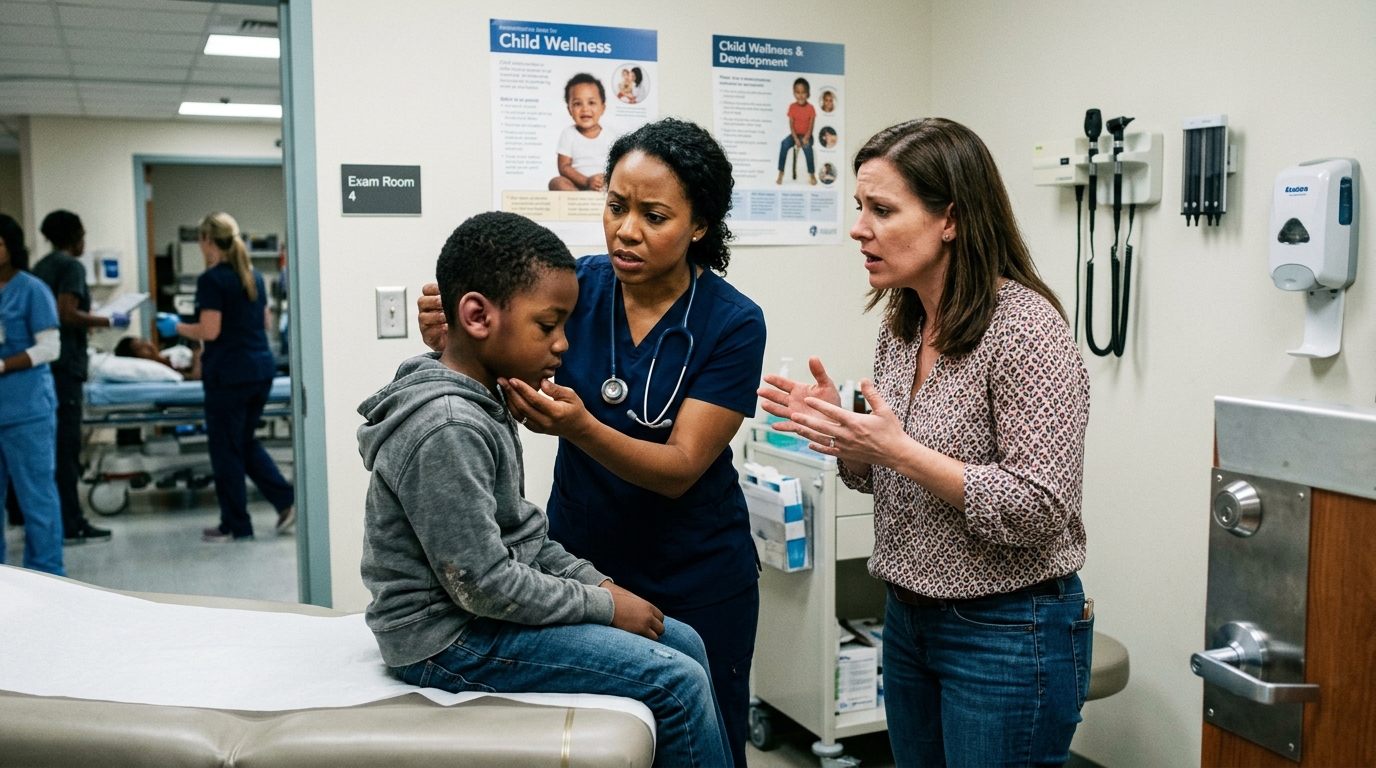
I’ve been an ER triage nurse in suburban Ohio for 12 years, but nothing could have prepared me for the quiet terror I saw in a seven-year-old boy’s eyes on a rainy Tuesday morning, or what I found hiding behind his swollen left ear.
Working in emergency pediatrics, you develop a sort of sixth sense. You learn to read the room before you even read the patient’s chart. You can tell the difference between a mother who is genuinely terrified because her toddler swallowed a coin, and a parent who is putting on a performance to cover up something much darker. I thought I had seen every trick, every lie, and every nervous tell. I thought I was unshakeable. But the moment Amanda and her son Leo walked through the double doors of my clinic, a cold knot formed in my stomach.
It was 9:15 AM. The ER was relatively quiet, filled only with the hum of the fluorescent lights and the steady drumming of the autumn rain against the large waiting room windows. The air smelled of industrial bleach and stale coffee. I was behind the intake counter, sorting through some discharge paperwork from the night shift, when the automatic doors slid open.
A woman in her early thirties walked in. She was wearing a high-end beige trench coat, perfectly styled blonde hair, and expensive-looking leather boots. She looked completely out of place in our sleepy, rural county hospital. But it wasn’t her appearance that caught my attention. It was her grip.
Her right hand was clamped down on the shoulder of a small boy, pulling him along slightly faster than his short legs could comfortably manage.
“I need a doctor for my son,” she announced loudly to the empty waiting room, her voice echoing off the linoleum floors. She marched straight up to my desk. “He had a little accident. It’s nothing serious, just a swollen ear, but his father insisted I bring him in just to be safe. You know how fathers are.”
She laughed. It was a high, thin, nervous sound that didn’t reach her eyes.
I stood up and offered a warm, professional smile. “I can absolutely help you with that. Let’s get you both into Triage Room 2.”
As I came around the counter, I finally got a good look at the boy. He was small for his age, maybe seven or eight years old. He was wearing a thick blue hoodie with the hood pulled up, despite being indoors. He kept his eyes glued to the floor. His hands were shoved deep into his pockets, and his shoulders were hunched forward.
“Hi there, buddy,” I said softly, crouching down slightly to try and catch his eye. “My name is Sarah. What’s your name?”
“His name is Leo,” the mother interrupted immediately. She didn’t let go of his shoulder. “And he’s very shy. He doesn’t like hospitals. Neither do I, to be honest. It’s just a bump, really.”
“Let’s take a look in the room, Leo,” I said, ignoring the mother for a fraction of a second to keep my focus on the patient.
We walked into the small examination room. I closed the door behind us, the heavy wood shutting out the ambient noise of the hospital. The room was bathed in the harsh, cool light of the overhead medical lamps.
“Alright, Leo,” I said, pulling over the rolling stool. “Can you hop up on the table for me?”
Leo hesitated. He looked up at his mother.
“Go on, Leo. Do what the nice nurse says,” she urged, giving him a small, rigid push toward the examination table.
He climbed up slowly. I noticed his movements were careful, guarded. He didn’t use his left arm to hoist himself up, relying entirely on his right side.
“Okay, Amanda, you said it was his ear?” I asked, pulling on a pair of fresh blue nitrile gloves.
“Yes, his left ear. It swelled up yesterday afternoon. It looks terrible, but I promise it’s worse than it feels. He was playing in the backyard with our neighbor’s dog. It’s a big Golden Retriever, very clumsy. The dog jumped up, knocked Leo completely off balance, and he fell hard against the wooden fence. Smacked the side of his head right on a post.”
She delivered the story quickly. Too quickly. It sounded rehearsed, like a monologue she had recited in the car mirror all the way here.
“I see,” I said neutrally. “Leo, I’m going to pull your hood down now, okay? I just need to see the bump.”
Leo didn’t say a word. He just closed his eyes tight.
I gently gripped the edge of the blue fabric and pulled it back.
I had to suppress a sharp intake of breath. The mother had called it a “bump.” That was the understatement of the century.
Leo’s left ear was swollen to three times its normal size. It was a deep, angry purple, mottled with furious red streaks. The skin was stretched so tight it looked shiny, threatening to split open. The swelling extended down his jawline and into his neck.
But it wasn’t just the sheer size of the injury that made my blood run cold. It was the pattern.
As a medical professional, you study the physics of trauma. If a child falls against a flat wooden post, you expect to see a diffuse area of impact. You expect to see scrape marks, maybe a bit of broken skin from the rough wood, and generalized swelling.
Leo’s ear didn’t look like he hit a fence post.
Running directly across the cartilage of the upper ear, extending backward into the hairline, was a distinct, narrow line of crushed tissue. It was perfectly straight. About half an inch wide. The bruising was concentrated heavily along this specific line, while the rest of the ear was swollen purely from the subsequent inflammation.
Furthermore, the back of his ear—the part that rests against the skull—was completely purple. If you fall and hit the side of your head, the outer ear takes the damage. The back of the ear is protected. The only way the back of an ear gets bruised like that is if it is forcefully bent forward and pinched, or if something wraps around it tightly.
This was not a blunt force impact from a fall. This was a sustained, localized pressure injury.
I kept my face completely neutral. Over a decade in the ER teaches you how to build a brick wall over your emotions. If the mother suspected I was onto her, she could grab the boy and walk out the door before I had the legal grounds to stop her.
“Wow, that is quite a bump, Leo,” I said softly, keeping my voice light and reassuring. “Does it hurt when I do this?”
I gently hovered my gloved finger an inch away from the swollen tissue, not actually touching it.
Leo flinched violently. He didn’t just pull away; his entire body curled inward, a profound, instinctual reaction to severe pain and fear.
“He’s just being dramatic,” Amanda sighed, crossing her arms over her expensive coat. “I gave him some Tylenol this morning. He’s fine.”
“A dog knocked him into the fence, you said?” I asked, turning to the computer to start a chart. I needed to keep her talking. The more a liar talks, the more rope they give you.
“Yes. A big Golden Retriever. Buster is his name. Sweet dog, but zero spatial awareness.”
“Did he hit his head on the ground too? Any nausea, dizziness, vomiting?”
“No, no. Just the fence post. Straight on the ear. He cried for a minute, I put some ice on it, and he went right back to playing.”
I typed meaningless letters into the keyboard just to make it look like I was documenting her story. My mind was racing. The timeline didn’t fit. She said it happened yesterday afternoon. The deep purple color of the hematoma and the specific stage of the swelling indicated this injury was at least 48 to 72 hours old.
The boy’s left ear had been swollen for at least three days.
“Leo,” I said, swiveling back around to face the boy. “Do you like playing with Buster the dog?”
For the first time since walking into the hospital, Leo opened his eyes and looked directly at me. His eyes were wide, a striking shade of pale blue, and they were swimming with unshed tears.
He didn’t look at his mother. He looked at me, and he very slowly shook his head side to side. A tiny, almost imperceptible movement.
“Oh, stop it, Leo,” Amanda snapped. Her voice lost the light, airy quality it had a moment ago. A sharp edge of irritation bled through. “You love Buster. You were just throwing the ball for him on Saturday.”
I froze. My fingers stopped typing.
Saturday.
Today was Tuesday.
She had just slipped up. She told me the accident happened yesterday afternoon. Now she was bringing up Saturday.
“Let me just get a quick set of vitals, okay?” I said, standing up and reaching for the blood pressure cuff. My heart was pounding against my ribs, but my hands were completely steady.
I wrapped the pediatric cuff around his right arm. As the machine hummed and squeezed, I took my stethoscope and placed it on his chest to listen to his heart and lungs.
“Take a deep breath for me, buddy,” I whispered.
As I leaned in close to his chest, placing my body between Leo and his mother to block her view for just a second, Leo tilted his head.
His lips barely moved. His voice was so quiet, so fragile, it was barely a breath against the ambient noise of the room.
“We don’t have a fence,” he whispered.
The blood pressure machine beeped.
I stood up straight, carefully pulling the stethoscope from my ears. I looked at the mother, Amanda, standing there with her arms crossed, tapping her expensive leather boot impatiently against the linoleum floor.
Her story had just fallen apart in thirty seconds.
There was no fence. The injury was three days old. The trauma marks were inconsistent with a fall. And the sheer terror radiating from the seven-year-old boy sitting on my table was palpable.
“His blood pressure is a little high,” I said calmly, turning to the counter. “And given the location of the swelling, I need to have one of our doctors do a deeper exam to make sure there’s no internal cartilage damage. Dr. Evans is our pediatric specialist on call today. Let me go grab him.”
“Is that really necessary?” Amanda asked quickly, stepping forward. The polite facade was cracking. “I really just wanted some prescription cream or something. We have places to be.”
“Hospital policy,” I lied smoothly. “Any head trauma requires a physician’s sign-off. It will just take a few minutes.”
I walked toward the heavy wooden door of the examination room. I needed to get to the hallway. I needed to get to the phone. I needed to call child protective services and hospital security.
I opened the door and stepped halfway out.
“I’ll be right back,” I said.
“Wait,” Amanda said. Her voice was completely different now. Cold. Flat.
I stopped and turned back.
Amanda was no longer looking at me. She was looking at Leo. And the expression on her face was something I will never forget. It was a look of pure, unadulterated warning.
She reached into her large designer purse.
“If this is going to take a long time,” she said slowly, her hand rummaging around inside the bag, “maybe we should just leave.”
I didn’t think. I just reacted. My survival instincts, honed by years of dealing with unpredictable situations in the ER, took over.
I stepped back into the room.
I grabbed the heavy metal handle of the examination room door.
And with one swift, forceful motion, I pulled it shut and turned the deadbolt, locking the three of us inside.
CHAPTER 2
The sound of the heavy brass deadbolt clicking into place was the loudest thing I had ever heard.
It echoed in the small, sterile examination room like a gunshot.
For a fraction of a second, nobody moved. The air in the room felt like it had suddenly been sucked out through the ventilation grate in the ceiling.
I stood with my back pressed against the heavy wooden door, my fingers still wrapped tightly around the cold metal of the lock. My heart was slamming against my ribs so violently I thought it might crack my sternum.
I had broken protocol. I had broken hospital rules. You never, ever lock yourself in a room with a potentially hostile person. You leave an escape route. You keep the door cracked.
But looking at the terrified seven-year-old boy sitting on the exam table, clutching his knees to his chest, I knew I didn’t have a choice.
Amanda’s hand was still buried deep inside her oversized, expensive leather designer bag.
Her perfectly manicured nails were out of sight.
My eyes were glued to the leather fabric of the bag, watching for the shape of a weapon. A gun. A knife. Anything. Working in a rural ER, you learn very quickly that people bring all sorts of dangerous things through the automatic sliding doors.
Slowly, Amanda pulled her hand out.
My muscles coiled, ready to lunge forward and put myself between her and the boy.
Her hand emerged empty.
She let the heavy leather strap of her purse slide off her shoulder, dropping the bag onto the linoleum floor with a heavy thud.
Then, she looked up at me.
The polite, nervous, wealthy suburban mother was gone. The facade had completely vanished, melting away to reveal something incredibly cold and deeply calculating beneath.
Her posture straightened. Her jaw clenched. The high-pitched, breathy voice she had been using was completely gone.
“Unlock that door,” she said.
Her voice was flat, low, and laced with absolute venom. It wasn’t a request. It was an order from someone who was very used to getting exactly what they wanted, no matter the cost.
“I can’t do that, Amanda,” I said, keeping my voice as calm and level as humanly possible. I employed every single de-escalation technique I had learned in twelve years of trauma nursing. “Hospital policy dictates that any child presenting with a traumatic head injury must wait for a physician’s clearance before leaving the premises.”
“I don’t give a damn about your policy,” she spat, taking a half-step toward me. “He is my son. We are leaving. Now.”
“Amanda, please,” I said, holding one hand up with my palm facing outward, a universal gesture for peace. “Let’s just wait for Dr. Evans. He’ll take a quick look at Leo’s ear, write you a prescription, and you can be on your way.”
I was lying through my teeth. Dr. Evans wasn’t going to write a prescription. He was going to call the state police.
I just needed to buy time.
Behind Amanda, sitting on the crinkly white paper of the examination table, little Leo hadn’t moved a muscle. He was curled into a tight ball, his face hidden against his knees.
He was trembling. I could see the thick blue fabric of his hoodie vibrating with the silent force of his fear.
“Leo doesn’t need a doctor,” Amanda said, her eyes narrowing into dangerous slits. “He needs to go home. He’s fine. Aren’t you fine, Leo?”
She snapped his name like a whip.
Leo flinched violently, but he didn’t look up. He gave a tiny, almost imperceptible nod against his knees.
“See?” Amanda said, turning her icy glare back to me. “He’s fine. Now open the damn door before I make a scene that will cost you your nursing license.”
I didn’t move.
Instead, I slowly slid my right hand behind my back.
In every triage examination room in our hospital, there is a small, red, rectangular panic button mounted exactly thirty-six inches off the floor, directly beneath the edge of the computer counter.
Pressing it doesn’t sound an audible alarm. It sends a silent, flashing “Code Gray” alert directly to the hospital security desk and the local police precinct. It means a staff member is in immediate physical danger.
I just had to reach it.
“Amanda, I understand you’re frustrated,” I said, keeping eye contact with her to distract from the movement of my arm. “Hospitals are stressful places. But looking at the bruising pattern on the back of Leo’s ear, and the timeline of the swelling, I have a legal obligation as a mandatory reporter to have a doctor examine him.”
I used the phrase “mandatory reporter” deliberately.
It was a test. An innocent parent would be confused. A guilty parent would panic.
Amanda’s eyes widened for a fraction of a second. The color drained from her cheeks, leaving her looking pale and sick under the harsh fluorescent lights.
She knew exactly what that phrase meant.
“You…” she stammered, taking another step toward me. She was now only three feet away. I could smell her expensive floral perfume masking the faint scent of stale cigarette smoke. “You have no idea what you’re talking about. You’re just a nurse. You don’t know my family.”
My fingers brushed the cold, smooth plastic of the computer counter.
“I know that your son whispered that you don’t have a fence,” I said softly, holding my ground.
The silence that followed was suffocating.
Amanda slowly turned her head to look at Leo. The absolute fury on her face made my blood run ice cold.
“You little liar,” she hissed through her teeth.
Leo let out a tiny, stifled sob. He pressed his hands over his ears, burying his head deeper between his knees.
“Hey,” I said sharply, raising my voice to draw her attention back to me. “Do not speak to him like that. Look at me.”
My fingers found the edge of the counter. I slid my hand underneath.
I felt the small plastic housing. I found the red button.
I pressed it down hard.
There was no sound. No flashing lights in the room. Just the quiet hum of the air conditioning. But I knew that down the hall, the security monitors were flashing blood red. Help was coming. I just had to keep her contained for two more minutes.
Amanda turned back to me. The anger in her eyes was suddenly replaced by something else. Panic. Real, desperate panic.
She looked at the locked door. She looked at me blocking it.
“You shouldn’t have done that,” she whispered, her voice trembling slightly. Not with fear, but with an unhinged adrenaline.
She immediately dropped to her knees and plunged both hands into her oversized leather purse on the floor.
My heart leaped into my throat. Weapon.
I stepped away from the door, bracing myself to tackle her.
But she didn’t pull out a weapon.
She pulled out a sleek, black smartphone.
Her fingers flew across the screen, desperately typing in a passcode. She brought the phone to her ear, her hands shaking so badly she almost dropped it.
She turned her back to me, pacing to the far corner of the tiny exam room.
I watched her closely, my mind racing. Who was she calling?
“Pick up, pick up, pick up,” she muttered under her breath.
Then, someone answered.
“It’s me,” Amanda said, her voice dropping to a frantic, breathless whisper. “We have a problem.”
She paused, listening to the voice on the other end.
“I’m at the county hospital,” she continued, shooting a terrified glance over her shoulder at me. “The nurse. She locked us in the room. She saw the ear. She knows.”
Another pause. The voice on the phone must have been screaming, because I could faintly hear the tinny, metallic sound of someone yelling through the earpiece.
“I couldn’t help it!” Amanda hissed back defensively. “It looked infected! I had to bring him in! But she’s holding us here. She said she’s a mandatory reporter.”
I took a slow, deliberate step toward the examination table.
While Amanda was distracted, pacing in the corner and whispering frantically into the phone, I needed to check on Leo.
I moved to his side. He was still curled into a tight ball, his entire body rigid with terror.
“Leo,” I whispered, leaning my head down close to his. “It’s Nurse Sarah. You are safe here. I locked the door to keep you safe.”
He didn’t move.
“Leo, look at me,” I pleaded softly.
Slowly, agonizingly, he lifted his head.
His pale blue eyes were completely bloodshot, tears streaming silently down his cheeks. The harsh overhead lights cast a brutal glare on his swollen, purple ear.
“Who is she talking to on the phone, Leo?” I whispered, keeping one eye on Amanda’s back.
Leo’s lips trembled. He swallowed hard.
“Him,” Leo breathed out. The word barely had any sound.
“Who is him?” I asked gently. “Your dad?”
Leo shook his head violently. “No. Not my dad. Her friend.”
“Did her friend do this to your ear, buddy?”
Leo looked at his mother. Amanda was still facing the wall, her voice rising in a frantic argument with the man on the phone.
“He… he twisted it,” Leo whispered, the tears flowing faster now. “Because I wouldn’t be quiet when he was working. He grabbed it and he twisted it hard until I heard a popping sound. He told my mom if she took me to the doctor, he would punish both of us.”
Bile rose in the back of my throat.
A pinch and crush injury. That explained the straight line of bruised cartilage. It explained the bruising on the back of the ear. The man hadn’t just hit him. He had grabbed the ear and twisted it with the brute force of a wrench until the cartilage snapped.
“Oh, sweet boy,” I breathed, my heart breaking into a million pieces. “I am so sorry.”
“He’s going to come here,” Leo whimpered, his eyes darting frantically around the small room. “He told her he tracks her phone. He knows where we are. If he comes here, he’s going to hurt you too.”
A cold chill washed down my spine.
I looked back at Amanda.
“Listen to me!” Amanda practically shrieked into the phone, her polite mask completely destroyed. “I am trapped! Get the truck to the loading dock in the back. The emergency exit. I’m going to find a way out of this room. Just be there!”
She hung up the phone and shoved it into her coat pocket.
She turned around and faced me.
There was a frantic, cornered-animal look in her eyes now. The kind of look that makes people incredibly dangerous.
“Open the door,” she said. It wasn’t a demand anymore. It was a threat.
“Security is on their way, Amanda,” I said, stepping firmly in front of Leo, using my body as a human shield between the mother and the son. “There is nowhere to go. Sit down.”
“You stupid bitch,” she snarled, balling her hands into fists. “You have no idea what you’ve just done. You have no idea who is coming to this hospital right now.”
“I don’t care who is coming,” I said, my voice rock steady, even though my hands were shaking. “No one is taking this boy.”
Amanda lunged at me.
She didn’t go for my face. She went straight for my scrubs, grabbing a handful of my uniform top near my collarbone, trying to physically throw me out of the way to get to the door.
She was stronger than she looked. The momentum pushed me backward, my shoulders slamming hard against the heavy wooden door.
“Get out of the way!” she screamed, her perfectly styled blonde hair falling into her wild eyes. She clawed frantically at my arm, trying to reach the deadbolt over my shoulder.
“Code Gray! Room 2!” I yelled at the top of my lungs, knowing the walls were thick, praying someone in the hallway could hear me.
I didn’t fight back. I just planted my feet, locked my knees, and used my body weight to block the lock. I grabbed her wrists, trying to peel her acrylic nails off my arms.
“Let us go!” she shrieked, kicking wildly at my shins.
Leo was screaming now on the exam table, the high, piercing sound of a child in absolute, unadulterated terror.
Suddenly, there was a deafening, booming sound from directly behind me.
BANG. BANG. BANG.
Someone was slamming their fists against the outside of the heavy wooden door.
“Security! Open the door!” a deep, authoritative voice boomed from the hallway. It was Marcus, our head of hospital security.
“Help us! She’s holding us hostage! She’s crazy!” Amanda screamed at the top of her lungs, instantly flipping the script, tears springing to her eyes on command.
“Step back from the door!” Marcus yelled from outside.
I heard the heavy rattle of a master key sliding into the exterior lock cylinder.
Amanda let go of me, instantly throwing herself onto the floor near the sink. She curled into a ball, covering her head with her hands, sobbing hysterically.
“Don’t hurt me! Please, don’t hurt us!” she wailed, her voice echoing off the tile.
The lock clicked open.
The heavy door was thrown open with tremendous force, banging against the metal doorstop.
Marcus rushed into the room, his hand resting on the taser at his belt. Right behind him was Dr. Evans, holding a medical chart like a shield.
They froze, taking in the chaotic scene.
Amanda was sobbing on the floor, pointing a trembling finger at me.
“Arrest her!” Amanda cried out, tears streaming down her perfect makeup. “She locked the door! She attacked me! We tried to leave and she physically assaulted me!”
Marcus turned his stern gaze to me. I was breathing heavily, my scrubs rumpled, red scratch marks forming on my forearms where she had clawed me.
“Sarah?” Dr. Evans asked, his brow deeply furrowed in confusion. “What the hell is going on in here?”
I didn’t look at Amanda. I didn’t look at Marcus.
I pointed a shaking finger toward the examination table.
“Dr. Evans,” I breathed out, my voice raspy from adrenaline. “Look at the boy’s ear.”
CHAPTER 3
“Look at the boy’s ear,” I repeated, my voice barely a whisper, but in the sudden, echoing silence of the examination room, it sounded like a shout.
Dr. Evans didn’t move for a second. He was a seasoned pediatrician, a man who had spent thirty years looking at childhood illnesses, broken bones, and scraped knees. He was used to frantic mothers and crying children.
But he was not used to walking into a locked triage room to find his head triage nurse barricading the door against a sobbing woman in a designer coat.
On the floor, Amanda wailed louder. It was a spectacular performance.
“She went crazy!” Amanda sobbed, burying her face in her hands, her shoulders heaving dramatically. “I just wanted a doctor for my son, and she locked us in! She grabbed me! Look at her, she’s unhinged!”
Marcus, our head of security, kept his hand firmly on the bright yellow grip of his taser. His eyes darted between me, pressed against the doorframe, and Amanda on the floor.
“Sarah,” Marcus said, his voice deep and commanding, demanding order. “Step away from the door. Hands where I can see them.”
I immediately raised my hands, palms open, and took two slow steps sideways, sliding my back along the cool drywall until I was completely clear of the exit. I wasn’t going to fight Marcus. I just needed him to see what I saw.
“I’m stepping away, Marcus,” I said, keeping my voice incredibly calm, contrasting sharply with Amanda’s hysterical shrieks. “The room is secure. But you need to listen to me. This is a Code Gray. The mother is a flight risk. She cannot leave this room.”
“She assaulted me!” Amanda screamed, pointing a perfectly manicured, trembling finger at my chest.
Dr. Evans finally tore his eyes away from the bizarre standoff between me and Amanda. He looked past us.
He looked at the examination table.
Leo was still sitting there. The heavy oak door slamming open, the shouting, his mother’s fake sobbing—none of it had made him move. He was completely frozen, curled into a tight, miserable ball, his face pressed so hard against his knees that his knuckles were white from gripping his own legs.
And sticking out from beneath the thick blue fabric of his hoodie was his left ear.
Even from six feet away, under the harsh glare of the overhead medical lights, it looked horrifying.
Dr. Evans lowered the medical chart he had been holding like a shield. The confusion on his face instantly vanished, replaced by the cold, sharp focus of a medical professional recognizing severe trauma.
He didn’t say a word to Amanda. He didn’t ask me what happened.
He just walked straight past the sobbing woman on the floor and approached the examination table.
“Hello there, Leo,” Dr. Evans said. His voice was entirely different now. It was low, incredibly gentle, and completely devoid of the tension that filled the rest of the room. “I’m Dr. Evans. I’m going to take a look at you now.”
Amanda’s fake sobbing hitched. She peeked through her fingers, realizing that her theatrical display wasn’t working. The doctor wasn’t paying attention to her victim routine.
“Don’t touch him!” Amanda snapped, her voice suddenly losing its tearful, helpless quality. “We are leaving! We don’t want your help!”
She scrambled to her feet, moving with a speed and agility that completely betrayed her “terrified victim” act. She lunged toward the examination table, reaching for Leo’s arm to drag him away.
Marcus was faster.
With the fluid grace of a former state trooper, Marcus stepped into her path. He didn’t draw his weapon, but he used his massive frame to completely block her access to the boy. He put one large, firm hand flat against the shoulder of her expensive beige trench coat.
“Ma’am, you need to step back,” Marcus ordered. It wasn’t a request. The friendly hospital security guard was gone; this was a law enforcement officer taking control of a volatile scene.
“Get your hands off me!” Amanda hissed, her face contorting with genuine, ugly rage. The polite suburban mother facade was completely shattered now.
“Ma’am, if you do not step back and calm down, I will place you in handcuffs for the safety of the staff and the patient,” Marcus said, his voice dropping an octave, radiating absolute authority. “Do you understand me?”
Amanda glared at him, her chest heaving. She looked at the door, but I was standing near it. She looked at the doctor, who was already leaning over her son. She was trapped, and she knew it.
She took a slow, venomous step back, crossing her arms tightly over her chest.
At the exam table, Dr. Evans pulled a pair of nitrile gloves from the wall dispenser. They snapped loudly in the quiet room as he pulled them over his hands.
“Leo, I need you to lift your head for me, just a little bit,” Dr. Evans murmured.
Leo didn’t want to move. I could see the absolute terror vibrating through his small frame. He let out a tiny, muffled whimper.
I stepped forward, moving slowly so I wouldn’t startle him.
“Leo, it’s Nurse Sarah,” I whispered, standing on the opposite side of the table from the doctor. “Remember what I told you? You are safe here. Nobody is going to hurt you in this room. Dr. Evans is just going to look, okay? He won’t touch it if you don’t want him to.”
Slowly, agonizingly, Leo uncurled. He lifted his head, his pale blue eyes wide and swimming with unshed tears. He kept his gaze locked on me, terrified to look at the doctor, and even more terrified to look at his mother.
Dr. Evans leaned in close. He adjusted the overhead surgical lamp, shining a bright circle of sterile white light directly onto the side of Leo’s head.
The doctor didn’t gasp. He didn’t react visibly. But I saw his jaw clench so tight that a muscle twitched violently in his cheek.
“The mother stated he was knocked into a wooden fence by a dog,” I said quietly, speaking directly to Dr. Evans, using clinical, detached language. “She stated the injury occurred yesterday afternoon. Patient presented with a single, localized hematoma, severe tissue swelling, and distinct linear bruising across the upper cartilage.”
Dr. Evans nodded slowly, his eyes scanning the horrifying purple mass.
“I see the tram-line bruising,” Dr. Evans muttered, almost to himself.
Tram-line bruising. It’s a very specific term we use in emergency medicine and forensics. It happens when a cylindrical object—like a rod, a tightly rolled magazine, or in this case, the edge of a thumb and a finger gripping with immense force—strikes or crushes the skin. The blood is forced outward from the point of impact, creating two distinct, parallel lines of dark bruising with a paler area of skin in the middle.
You don’t get tram-line bruising from falling against a flat wooden fence.
“I also note severe ecchymosis on the posterior aspect of the auricle,” Dr. Evans continued, his voice cold and clinical.
He meant the back of the ear. The part that was completely protected by the skull.
Dr. Evans gently reached out and rested two fingers on Leo’s uninjured right shoulder, offering a comforting anchor.
“Leo,” Dr. Evans said softly. “This injury is older than yesterday, isn’t it?”
Leo squeezed his eyes shut. He didn’t say anything.
“Don’t you dare put words in my son’s mouth!” Amanda shouted from across the room, trying to step around Marcus. “You are trying to trap him! He’s confused! We told you what happened!”
“Marcus,” Dr. Evans said, not even turning his head to look at her. “Remove the mother from the room. Put her in Interview Room A down the hall. Lock the door from the outside. She is not to have access to a phone.”
“You can’t do that!” Amanda shrieked, her voice echoing shrilly off the tiles. Panic was fully setting in now. “That’s illegal! You’re kidnapping my son! I want a lawyer! I’m calling the police!”
“I am the police, ma’am,” Marcus said gruffly. He grabbed her by the upper arm, his grip firm and unyielding. “And we have a protocol for suspected severe child abuse. You’re coming with me right now.”
Amanda fought. She dug her expensive leather boots into the linoleum, twisting and thrashing like a wild animal caught in a snare. She tried to scratch Marcus’s hands, kicking backward at his shins.
But Marcus was a professional. He simply shifted his weight, secured her arm behind her back in a textbook control hold, and marched her forcefully out of the examination room.
“Leo! Don’t you say a word to them! Do you hear me?!” Amanda screamed as she was pushed out into the hallway. “If you tell them anything, you know what he’s going to do! Keep your mouth shut!”
Her shrieks faded as Marcus dragged her down the long corridor toward the secure holding rooms.
Then, the heavy wooden door swung shut on its automatic hinges, clicking softly.
The room was suddenly, blissfully quiet.
It was just me, Dr. Evans, and a terrified seven-year-old boy.
Leo let out a long, shuddering breath. It sounded like he had been holding it in since he walked through the front doors of the hospital. His shoulders slumped, and the rigid tension in his body seemed to deflate just a fraction.
“She’s gone, Leo,” I said softly, pulling the rolling stool closer to the table and sitting down so I was at eye level with him. “It’s just us.”
Dr. Evans pulled up a stool on the other side.
“Leo, I need to be very honest with you,” Dr. Evans said gently. “I have been a doctor for a very long time. I know what a bump from a fence looks like. And I know what it looks like when an adult hurts a child on purpose. Your ear was crushed. Someone grabbed it, bent it forward, and squeezed it very, very hard.”
Leo stared down at his hands, which were twisted tightly together in his lap. A single tear escaped and tracked down his pale cheek, falling onto the blue fabric of his hoodie.
“I need to document this, Leo,” Dr. Evans said. “I’m going to take a few pictures with the hospital tablet. Is that okay?”
Leo gave a tiny nod.
As Dr. Evans retrieved the medical tablet from the wall mount, my mind raced back to the chaotic moments before they busted through the door.
The phone call.
My blood ran cold as the memory hit me.
“Dr. Evans,” I said sharply, standing up from the stool. “The mother. Before you came in, she was on the phone.”
Dr. Evans paused, the tablet half-raised. “Who was she calling?”
“She was calling the man who did this,” I said, my heart rate spiking again. “Leo told me. The man’s name is Trent. He’s not the father, he’s a friend. He twisted Leo’s ear on Saturday because Leo was making too much noise.”
Dr. Evans’s face darkened with a mixture of profound sorrow and absolute fury. He looked at Leo.
“Is that true, Leo?” Dr. Evans asked softly.
“Yes,” Leo whispered, his voice trembling. “Trent got mad. He was working in the garage and I dropped a metal bucket. It made a loud noise. He came inside and he grabbed me.”
Leo reached up with his uninjured right hand and touched the air near his left ear, unable to bear actually touching the swollen flesh.
“He twisted it like a key,” Leo sobbed quietly. “He twisted it until I heard a loud popping sound inside my head. And he told me if I cried, he would do the other one.”
I felt a wave of nausea wash over me. The “popping sound” was the auricular cartilage snapping under the sheer torsion force. The man had literally broken the framework of the boy’s ear.
“And she called this man?” Dr. Evans asked me, his voice tight.
“Yes,” I nodded frantically. “He tracks her phone. He knew she brought Leo to the hospital. When I locked the door, she panicked. She called him and told him to come here. She told him to come to the emergency loading dock at the back of the hospital.”
Dr. Evans set the tablet down on the counter. He didn’t hesitate.
He reached over and grabbed the landline phone on the wall. He dialed a three-digit internal extension.
“Security dispatch, this is Dr. Evans in Triage Room 2,” he said, his voice hard and fast. “I need a facility-wide Code Yellow immediately. We have a confirmed hostile incoming threat. The suspect is male, name is Trent. The mother of the patient in Interview Room A just instructed him to breach the hospital via the rear emergency loading dock. Lock down all external doors. Now.”
He slammed the phone back onto the receiver.
Code Yellow. It meant external lockdown. All automatic sliding doors at the main entrance were deactivated. All emergency exits required keycard access. The hospital was effectively sealing itself off.
“Okay,” Dr. Evans said, turning back to Leo. He forced his features to soften, hiding the intense urgency of the situation from the child. “Let’s get those pictures, buddy. And then Nurse Sarah is going to get you some strong medicine so that ear stops hurting so much.”
I moved to the medical supply cabinet, my hands shaking slightly as I unlocked the narcotic drawer. I drew up a pediatric dose of liquid pain medication.
“Here you go, sweetheart,” I said, handing Leo the small plastic cup. “Drink this down. It tastes like fake cherry, but it’s going to make you feel a lot better in about fifteen minutes.”
Leo took the cup with a trembling hand and swallowed the thick liquid.
“Dr. Evans,” I whispered, stepping close to the doctor as he reviewed the photos on the tablet. “If this guy is crazy enough to break a child’s ear over a dropped bucket, and crazy enough to come to a hospital when he knows the authorities are likely involved…”
“I know,” Dr. Evans said grimly. “He’s not coming to check on them. He’s coming to silence them before they can talk to the police.”
Suddenly, the overhead PA system crackled to life.
It wasn’t a pre-recorded message. It was Marcus, his voice echoing loudly through the corridors of the ER.
“Attention all ER staff. Code Yellow is in effect. Secure all patients in their current locations. Do not enter the central hallways.”
There was a brief pause, filled with the loud burst of static.
Then, Marcus’s voice came back, and this time, he sounded out of breath.
“Dr. Evans, Nurse Sarah,” Marcus broadcasted over the open channel, a massive breach of protocol that told me exactly how bad the situation had just become.
“We have a breach at the loading dock. A dark gray pickup truck just rammed the reinforced security doors. The suspect has exited the vehicle. He has a weapon. Repeat, the suspect is armed and is inside the building.”
CHAPTER 4
“The suspect has exited the vehicle. He has a weapon. Repeat, the suspect is armed and is inside the building.”
The PA system clicked off, leaving behind a silence so absolute, so suffocating, it felt like the oxygen had been vacuumed from Triage Room 2.
For three seconds, nobody moved. The sheer impossibility of the situation paralyzed us.
This was a quiet, rural county hospital in Ohio. We dealt with farming accidents, winter car crashes, and the occasional bar fight. We did not deal with active, armed breaches.
But the terror in seven-year-old Leo’s eyes wasn’t a drill. It was a promise.
Leo let out a sound that I will never, ever forget as long as I live. It wasn’t a scream. It was a high, thin, whistling sound—the sound of an animal that knows it has been hunted down and trapped.
He scrambled backward on the examination table, pressing his small back so hard against the wall I thought he might break through the drywall.
“He’s here,” Leo whimpered, his hands flying up to cover his face, terrified of even bumping his broken, swollen ear. “He’s going to kill us. He told my mom he would.”
“No, he’s not,” Dr. Evans said.
The doctor’s voice was no longer the gentle, reassuring tone of a pediatrician. It was the hard, commanding bark of a man who had served as a trauma surgeon in the military before settling down in our sleepy town.
Dr. Evans moved with a terrifying, efficient speed.
“Sarah, help me,” he ordered, grabbing the edge of the heavy metal medical supply cabinet bolted near the sink. “The door lock won’t hold against a bullet. We need a barricade. Now.”
My paralysis broke. Adrenaline, cold and sharp as crushed ice, flooded my veins.
I threw myself against the side of the metal cabinet. I didn’t care about the scratches on my arms or the fact that my scrubs were tearing. I pushed with every single ounce of strength I had in my body.
Together, Dr. Evans and I dragged the massive, steel-framed cabinet across the linoleum floor. The metal feet shrieked against the tiles—a horrible, grating sound that I prayed wouldn’t give away our exact location.
We slammed the cabinet flush against the heavy wooden door.
“The ultrasound machine,” Dr. Evans pointed to the bulky, rolling diagnostic cart in the corner. “Wedge it behind the cabinet. Lock the wheels.”
I practically threw the machine across the room, slamming it against the cabinet and stomping down on the wheel locks.
We had created a massive wall of steel and heavy electronics. If Trent wanted to get into Triage Room 2, he was going to have to blow the door entirely off its hinges.
“Get him down,” Dr. Evans whispered urgently, pointing at Leo. “Get him on the floor. Behind the exam table. Out of the line of sight from the door frame.”
I rushed over to the examination table.
“Come here, Leo. Into my arms, right now,” I said.
He didn’t hesitate. He threw himself off the table, burying his face into my shoulder. He was so incredibly small, and he was shaking so violently that my own teeth rattled as I held him.
I dragged him into the narrow gap between the heavy steel base of the examination table and the far wall. It was a tight, suffocating space, smelling strongly of industrial bleach and dust, but it was completely out of the direct line of fire if someone shot through the doorway.
Dr. Evans crouched down right in front of us, using his own body as the final layer of protection. He reached into his coat pocket and pulled out his cell phone, his thumb hovering over the screen.
“I’m texting dispatch,” Dr. Evans whispered, his eyes fixed on the barricaded door. “Telling them exactly where we are. The police are already on their way. Three minutes away.”
Three minutes.
In an active shooter situation, three minutes is an absolute eternity. It is a lifetime.
Somewhere, deep in the hospital, a fire alarm began to blare. The piercing, rhythmic strobe lights flashed through the small crack under our door, painting our shoes in brief, frantic bursts of red light.
Then, we heard it.
The sound of shattering glass.
It was distant at first, echoing down the long, sterile corridors from the direction of the emergency loading dock.
But it was followed immediately by a sound that made my stomach drop into my shoes.
Crack. Crack.
Gunfire.
Not the muffled, cinematic sound you hear in movies. It was deafening, concussive, and unimaginably violent. The sound waves physically hit my chest, even through the walls.
Leo clamped his hands over his uninjured ear, burying his face deeper into my scrubs, sobbing silently.
“Shh, baby, I’ve got you,” I breathed into his hair, wrapping my arms around him as tightly as I dared, trying to make him as small as possible. “I’m right here. I’m not letting him touch you.”
“Where is she?!”
The voice boomed down the hallway.
It was guttural. Enraged. Completely unhinged.
Trent.
He was moving fast. The heavy thud of his boots echoed against the linoleum. He wasn’t sneaking around. He was rampaging.
“Where is my wife?! Where is the kid?!” Trent roared.
Amanda wasn’t his wife. She was his girlfriend. But in his twisted, possessive mind, he owned them both.
“Sir, drop the weapon! Drop it right now!”
Another voice. A younger man. It sounded like Kevin, one of our rookie security guards who monitored the secondary entrance.
Crack.
A single gunshot.
Then, a sickening thud.
I squeezed my eyes shut, fresh tears burning my vision. I prayed to God Kevin was just taking cover, but the heavy, triumphant sound of Trent’s boots moving forward told me otherwise.
He was getting closer.
He was in the main ER hallway now. Triage Room 2 was only fifty feet away.
Dr. Evans shifted his weight. He reached over and silently clicked off the overhead medical lights.
The room plunged into an eerie, shadowy darkness, lit only by the frantic red flashing of the fire alarm from the crack under the door, and the faint, glowing green light of the medical monitors.
“Amanda!” Trent screamed, his voice raw and echoing off the tile right outside our door.
He was in our corridor.
My heart hammered against my ribs like a trapped bird. The sound was so loud in my own ears I was terrified he would hear it through the wood.
Leo was hyperventilating. His breath came in short, raspy gasps against my neck. If he made a loud noise, we were dead.
I pressed my lips directly to his uninjured ear.
“Hold your breath, Leo,” I mouthed silently. “Play dead. Play completely dead.”
The heavy, stomping footsteps stopped.
They stopped directly outside our door.
The silence that followed was the most agonizing, terrifying moment of my entire life. I could hear the faint, ragged sound of someone breathing heavily on the other side of the heavy oak door.
He was standing right there.
Separated from us only by two inches of wood, a metal cabinet, and a rolling cart.
Suddenly, the brass handle of the door jerked downward violently.
The deadbolt held.
A string of vicious, whispered curses drifted through the wood.
Then, the heavy thud of a fist slamming against the door.
“Amanda, I swear to God, if you’re in there, open the damn door,” Trent hissed. The rage in his voice was chillingly calm now. It was the voice of a predator who knows its prey is cornered. “You told me Triage 2. Open it.”
We didn’t breathe. We didn’t move a single muscle.
Dr. Evans was holding a heavy metal oxygen tank wrench he had grabbed from the wall, his knuckles completely white, prepared to swing if the door gave way.
“Open it!” Trent roared, suddenly losing his temper again.
He kicked the door.
The heavy wood groaned. The metal cabinet we had shoved against it shuddered, screeching slightly against the floor.
He kicked it again, harder this time. The doorframe splintered. Dust rained down from the ceiling tiles.
He knew we were in here. He knew the door was barricaded.
“Fine,” Trent snarled. “I’ll open it myself.”
The unmistakable, mechanical click of a shotgun being racked echoed through the hallway.
“Down!” Dr. Evans hissed, flattening himself against the floor.
I threw my entire body over Leo, covering his head with my arms, pressing him flat against the cold tiles.
BOOM.
The sound was apocalyptic. The center of the heavy wooden door simply ceased to exist, exploding inward in a shower of jagged splinters and deadly shrapnel.
Wood chips rained down on my back. The smell of sulfur and burnt gunpowder instantly filled the tiny room, choking my lungs.
Through the massive, jagged hole in the door, a beam of harsh hallway light poured in, illuminating the thick dust hanging in the air.
Trent had shot the lock right out of the frame.
He kicked the door again. The ruined wood gave way, swinging inward.
But it immediately slammed against the massive steel supply cabinet we had dragged in front of it.
The door stopped dead. It only opened about four inches.
“What the hell?” Trent muttered, shoving his shoulder against the wood.
The barricade held. The combined weight of the steel cabinet and the locked ultrasound machine wouldn’t budge, no matter how hard he pushed.
“Move it!” Trent screamed, shoving the barrel of the shotgun through the narrow, four-inch gap between the door and the frame.
He couldn’t see us. He was blindly sweeping the barrel back and forth, trying to find a target.
“I know you’re in there, you stupid bitch!” Trent yelled. “Send the kid out right now, and I’ll let you live!”
I squeezed Leo tighter, my own tears soaking his hair. I would die on this floor before I let that monster touch this little boy again.
Suddenly, from the far end of the hallway, a new voice cut through the chaos.
“Police! Drop your weapon! Drop it now!”
The cavalry had arrived.
“Back off!” Trent screamed, pulling the shotgun barrel out of our doorframe and spinning around to face the hallway.
“Sheriff’s Department! Drop the firearm immediately or we will shoot!”
There were at least a dozen heavily booted footsteps rushing down the hall.
Trent didn’t drop his weapon. I heard him rack the shotgun again.
“I’m not going back to prison!” Trent roared.
“Fire! Fire!”
The hallway erupted into a deafening, terrifying cacophony of sound. A barrage of gunfire ripped through the air, so loud and sustained that my ears instantly began to ring with a high-pitched whine.
I squeezed my eyes shut and held Leo as the world exploded around us.
Bullets hit the walls outside, sending showers of drywall dust cascading into our room. The sheer concussive force vibrated through the floorboards directly into my chest.
Then, a heavy thud against our barricaded door.
A wet, sliding sound.
And then, absolute silence.
The gunfire stopped. The only sound left was the distant blare of the fire alarm and the ringing in my own ears.
“Suspect is down! Weapon is secure!” a deep voice yelled from the hallway. “Clear the corridor! We need medical out here, now!”
Dr. Evans slowly lifted his head. He looked back at me, his face pale, covered in dust, but alive.
He held up a finger to his lips, signaling for us to stay hidden. He wasn’t taking any chances until he knew for absolute certain it was the police.
“Is there anyone in Triage 2?!” a deputy shouted, banging heavily on the metal frame of the destroyed door. “This is the county sheriff’s department! You are safe! Are you injured?”
Dr. Evans let out a massive, shuddering breath. He dropped the metal wrench.
“We are here!” Dr. Evans shouted back, his voice cracking slightly. “We are unharmed! But the door is barricaded. We need to move it.”
“Stand clear, Doc, we’ll push from out here.”
It took the combined effort of three deputies pushing from the hallway, and Dr. Evans and I pulling from the inside, to finally shift the heavy metal cabinet enough to open the shattered door.
When the gap was wide enough, a deputy in heavy tactical gear stepped into the room. He took one look at our dust-covered faces and the terrified child clutched in my arms, and his hard expression instantly softened.
“It’s over, ma’am,” the deputy said gently, reaching out a gloved hand. “You’re safe. We’ve got you.”
I looked down at Leo.
He was perfectly still. His eyes were wide, staring blankly at the wall. The shock was setting in, deep and profound.
I picked him up. I didn’t care that he was seven years old and heavy. I scooped him into my arms like a toddler, supporting his back and keeping his head tucked safely against my chest so he wouldn’t look out into the hallway.
“I’m going to cover your eyes, Leo,” I whispered, resting my hand gently over his face. “We’re going to go for a walk now.”
I stepped out of Triage Room 2.
The hallway looked like a war zone. The walls were pockmarked with bullet holes. Ceiling tiles hung at jagged angles.
And lying on the floor, surrounded by deputies, was Trent.
He was alive, but barely. Paramedics from the ambulance bay were already swarming him, cutting away his blood-soaked shirt, fighting to stabilize the man who had just tried to slaughter us.
I didn’t stop. I didn’t look at him for more than a fraction of a second. I just tightened my grip on Leo and followed the deputy down the opposite corridor, toward the secure pediatric ward deep inside the hospital.
The next few hours were a chaotic blur of police interviews, statement writings, and adrenaline crashes.
We learned that Kevin, the security guard who had confronted Trent at the entrance, was alive. He had been shot in the shoulder, but the bullet missed his vital organs. He was already out of surgery and recovering in the ICU.
Amanda, the mother, never made it out of Interview Room A.
Marcus had kept her locked in there the entire time. When the police finally went in to arrest her, she tried to claim she was a hostage, a victim of Trent’s madness.
But the detectives had already pulled her phone records. They had the text messages. They had the timeline.
Amanda knew exactly what Trent had done to her son’s ear on Saturday. She had kept Leo home from school on Monday, hoping the swelling would go down. When it got worse on Tuesday, she concocted the story about the dog and the fence, terrified that Trent would follow through on his threat to hurt her if she got him in trouble.
And when I locked the clinic door, when she realized her lie had failed, her first instinct wasn’t to protect her child.
Her first instinct was to call the monster and tell him to silence the nurse who had figured it out.
She was charged with felony child endangerment, conspiracy, and acting as an accessory to attempted murder. She was placed in handcuffs, led out the front doors of the very hospital she had turned into a nightmare, and shoved into the back of a squad car.
It was nearly midnight when I finally finished my police statement.
I was exhausted. My scrubs were ruined, covered in drywall dust and dirt. My arms ached from barricading the door, and my hands were still trembling slightly.
Before I clocked out, I walked up to the third floor. The pediatric ward.
It was quiet up there. The lights were dimmed to a soft, comforting yellow.
I found Dr. Evans standing outside Room 314, leaning heavily against the wall, staring through the glass observation window.
I walked up and stood next to him.
Inside the room, Leo was fast asleep in the hospital bed.
His left ear was heavily bandaged, a thick white pad covering the broken, ruined cartilage. He had an IV in his small arm, delivering strong pain medication and antibiotics directly into his system.
But for the first time since he walked into my triage room that morning, he didn’t look terrified.
He just looked like a little boy.
Sitting in the chair next to his bed, holding his uninjured right hand, was a woman in her late fifties. She had kind eyes and graying hair.
“His grandmother,” Dr. Evans said softly, answering my unspoken question. “Child Protective Services tracked her down a few hours ago. She lives two counties over. She had no idea. Amanda had cut contact with her over a year ago when she started dating Trent.”
I watched the grandmother gently stroke Leo’s hair.
“She’s petitioning for emergency custody in the morning,” Dr. Evans continued, his voice rough with emotion. “The social worker says it’s practically a done deal. Amanda and Trent are never going to see this boy again.”
A heavy, profound wave of relief washed over me, so strong it almost buckled my knees.
We had done it.
We had broken the cycle. We had stopped the nightmare.
“You saved his life today, Sarah,” Dr. Evans said, turning to look at me. “If you hadn’t noticed the bruising pattern. If you hadn’t locked that door. If you had just let her walk out with a prescription cream…”
He didn’t finish the sentence. He didn’t need to. We both knew exactly what would have happened to Leo if he had gone back to that house.
“I just looked at his ear, Doc,” I whispered, my voice thick with tears.
“No,” Dr. Evans said firmly. “You looked at the patient. You read the room. You trusted your gut.”
I nodded slowly, wiping a tear from my cheek.
Working in the ER changes you. It strips away your innocence. You see the darkest, ugliest, most horrific things that human beings are capable of doing to one another, and you see it on a daily basis.
You learn to suspect the worst. You learn to look for the lie behind the polite smile.
Sometimes, that hyper-vigilance feels like a curse. It makes it hard to trust people. It makes it hard to sleep at night.
But as I stood there in the quiet hallway, watching a terrified little boy finally rest peacefully in the arms of someone who truly loved him, I realized something.
That sixth sense, that cold knot in the stomach, that instinct to pull the heavy wooden door shut and turn the deadbolt… it wasn’t a curse at all.
It was a shield.
And as long as I wore these blue scrubs, I was going to use it to protect every single child who walked through my doors.