The wind cutting through Oak Haven Cemetery wasn’t just cold; it felt malicious.
It was the kind of bitter, biting November chill that sank straight through your boots and settled deep into your bones.
I pulled my wool collar up against my neck, staring down at the granite headstone of my old squadmate, Miller.
I came here every Sunday at 2:00 PM.
It was a routine I’d kept since I retired from the service four years ago, a silent promise between two men who had seen too much sand and blood.
Usually, the cemetery was completely empty at this hour.
People didn’t like to linger among the dead when the sky was this heavy and grey.
But for the past month, I hadn’t been the only regular.
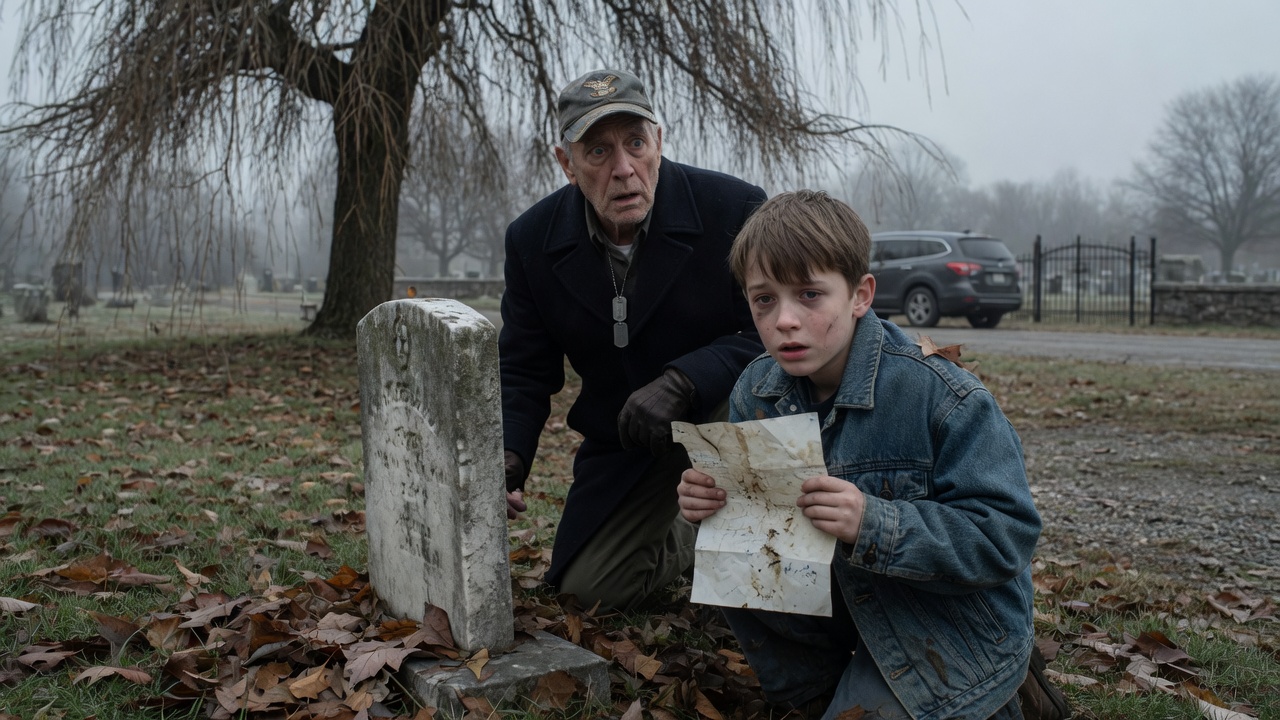
Two rows down, partially obscured by the drooping, skeletal branches of a massive weeping willow, sat a boy.
He looked to be about nine years old.
He was incredibly small for his age, practically swallowed by a faded, oversized denim jacket that was entirely useless against the freezing temperatures.
The first time I saw him, I figured he was just waiting for a parent who was tending to another grave nearby.
I had given him a polite, tight-lipped nod and gone about my business.
But the parent never appeared.
The second week, he was there again, sitting in the exact same spot.
By the third week, my military instincts had officially kicked in.
Something about the entire situation felt deeply, fundamentally wrong.
Children in cemeteries usually display a specific set of behaviors.
They are either utterly bored, kicking at gravel and dragging sticks against iron fences, or they are profoundly sad, holding a parent’s hand while tears stream down their faces.
This boy was neither.
He didn’t act like a grieving child.
He acted like a guard on duty.
His posture was rigid, his knees pulled tight to his chest, his eyes constantly scanning the perimeter of the wrought-iron fence that separated the graveyard from the winding county road.
He never brought flowers.
He never touched the headstone.
In fact, he deliberately sat with his back to the grave, facing outward, watching the road like he was expecting an ambush.
And then there was today.
The sky was the color of a bruised plum, threatening freezing rain at any moment.
The temperature had plunged below freezing, the wet grass crunching like broken glass under my boots.
I stood silently behind Miller’s tall headstone, out of the boy’s direct line of sight, just watching him.
He was shivering violently.
Even from fifty feet away, I could see his small shoulders shaking, his teeth chattering so hard I could almost hear the rapid clicking over the howling wind.
He kept rubbing his bare, raw-red hands together, desperately trying to generate friction.
But he didn’t leave.
He refused to leave.
Suddenly, the boy’s head snapped up.
A vehicle was slowly creeping down the county road just outside the cemetery gates.
It was a dark, heavily tinted SUV, moving at a suspicious crawl, its tires barely making a sound on the frozen asphalt.
The moment the boy spotted the grill of the vehicle, his entire demeanor changed.
He didn’t just look scared; he looked terrified.
He immediately flattened himself against the freezing mud, scrambling behind the wide marble base of the gravestone he had been guarding.
He pressed his face into the dirt, making himself as small as physically possible.
My heart hammered a familiar, steady rhythm against my ribs.
Twenty years of deployments had taught me the distinct difference between a child playing a game of hide-and-seek and a child who was genuinely fearing for his life.
This boy was in pure survival mode.
The SUV paused directly outside the wrought-iron gates.
The engine idled with a low, menacing hum that vibrated through the quiet air.
I shifted my weight, instinctively dropping into a lower stance, my hand brushing against the cold metal of the pocket knife clipped to my belt.
I waited for a door to open. I waited for boots to hit the pavement.
But nobody got out.
Instead, the passenger side window rolled down exactly two inches.
I couldn’t see a face inside the dark cabin, but I could feel the scrutiny.
Whoever was in that vehicle was scanning the cemetery.
They were looking for him.
Seconds stretched into agonizing minutes.
The boy didn’t move a single muscle. He was barely breathing.
Finally, the brake lights flickered, the engine revved, and the dark SUV slowly pulled away, disappearing around the bend of the forest road.
The heavy silence of the graveyard returned, broken only by the wind.
I watched the boy slowly peek his head around the edge of the stone.
When he realized the road was clear, he let out a ragged, gasping breath that turned to thick white mist in the freezing air.
He didn’t stand up.
Instead, he turned around, dropping to his bruised knees, and began to frantically claw at the semi-frozen earth at the base of the grave.
He was digging.
Not deep, just moving the top layer of frost-hardened topsoil and dead grass.
He was desperate, his small fingers hooking into the freezing mud, scraping it away with a chaotic urgency.
That was the breaking point for me.
I couldn’t just stand there and watch a freezing, terrified child dig through a grave.
I stepped out from behind Miller’s headstone.
I deliberately made my footsteps heavy. I wanted him to hear me coming so I wouldn’t startle him into a panic.
Crunch. Crunch. Crunch.
The boy froze instantly.
He whipped his head around, his eyes wide and completely white around the edges, like a wild horse about to bolt.
“Hey there, buddy,” I called out softly, keeping my hands raised, palms open to show I wasn’t a threat. “I’m not going to hurt you.”
He didn’t say a word.
He just scrambled backward, his boots slipping on the icy grass.
As he retreated, he violently snatched something from the shallow hole he had just dug.
He clutched it fiercely to his chest.
It was a piece of paper.
A thick, folded letter, heavily stained with dark mud and something else that looked suspiciously like dried rust.
“Stay away from me!” the boy croaked.
His voice was hoarse, raspy, as if he hadn’t spoken in days or had been screaming for hours.
“Take it easy,” I said, stopping exactly where I was. I slowly lowered myself into a crouch, making myself smaller, less imposing. “I’m just visiting my friend over there. I’ve seen you here a few times. You look freezing, kid. Where are your folks?”
The boy’s eyes darted frantically around the empty cemetery, checking the trees, checking the gates, checking the shadows.
“They’re coming back,” he whispered, his entire body trembling so hard he could barely keep his balance. “They know I’m here.”
“Who’s coming back?” I asked, my voice low and steady. “The people in that car?”
He didn’t answer. He just squeezed the crumpled letter tighter against his thin jacket.
“Whatever you have there,” I said gently, taking one slow, calculated knee forward. “You don’t have to hide it from me. I’m a soldier. I protect people.”
I reached into my coat collar and pulled out my silver dog tags, letting them catch the dull, grey light of the afternoon sun.
The boy stared at the metal tags.
For a fleeting second, the sheer panic in his eyes softened into something else. Exhaustion. Pure, unadulterated exhaustion.
He was a little kid carrying a weight meant for a giant.
“I have to put it back,” he muttered, his voice breaking. Tears finally spilled over his frozen, dirt-smudged cheeks. “He said I have to put it back exactly where I found it, or they’ll find her.”
“Find who?” I pressed, closing the distance between us by another two feet. I could see the state of his hands now. His knuckles were completely raw, bleeding slightly from scraping against the frozen dirt.
“My sister,” he sobbed, the tough exterior finally cracking.
He looked down at the crumpled, filthy letter in his hand.
It was folded unevenly, sealed with a thick piece of silver duct tape that was peeling at the edges.
“Please,” the boy begged, holding the letter out to me with trembling hands, but still refusing to fully let it go. “You have to help me hide it again. Before the car comes back. They can’t know I took it.”
I didn’t reach for the dirt.
I reached for the letter.
“Let me see it,” I commanded softly. Not a request, but a gentle order.
The boy hesitated, sniffing loudly, wiping a trail of freezing snot from his nose with his bruised wrist.
Slowly, his stiff, frozen fingers uncurled.
I took the letter from him.
The paper was thick, heavy, like expensive stationary, but it was ruined by the damp earth and the dark stains.
I carefully turned it over.
There was no name on the front. No address.
Just three words written in thick, aggressive black marker.
Three words that made the blood in my veins run completely cold.
I looked at the boy.
Then I looked at the gravestone he had been sitting in front of for a month.
I finally read the name carved into the old, weathered marble.
It wasn’t a family member’s grave.
It wasn’t a stranger’s grave.
It was my name.
CHAPTER 2
It was my name.
Johnathan Arthur Vance.
The letters were deeply carved into the cold, weathered marble, perfectly aligned beneath a bronze military medallion that had long since oxidized into a dull, chalky green.
Below my name was my date of birth.
And right beneath that, the date I had supposedly died in a sun-baked, blood-soaked valley in Afghanistan over a decade ago.
I stared at the headstone, the freezing November wind suddenly feeling completely non-existent.
My mind went completely blank, overwhelmed by a bizarre, suffocating wave of vertigo.
It was a cenotaph. An empty grave.
When my Humvee was hit by an IED and my squad was ambushed, Miller had died instantly.
I had been dragged away, bleeding and unconscious, into the mountains, presumed KIA by the military after a brutal three-week search turned up nothing but my helmet and a massive amount of my blood in the sand.
My grieving family had bought this plot right next to Miller’s, burying an empty casket with full military honors because they had no body to put in it.
When I was finally rescued from a dark, subterranean cave by a Special Forces unit eighteen months later, I came home a living ghost.
I never had the headstone removed.
It felt wrong to destroy it. The man I was before that ambush had genuinely died in that valley. The man who came back was someone else entirely.
So, I let the empty grave remain, using it as a quiet, undisturbed place to sit with Miller every Sunday.
But nobody knew that.
Except for the boy kneeling in the freezing mud right in front of me.
“Give it back!” the boy suddenly shrieked, his raspy voice pulling me violently back to the present reality.
He lunged at me, his small, bruised hands clawing frantically at the heavy, dark winter coat I wore.
He wasn’t just trying to get the letter; he was fighting for his life, driven by a primal, desperate panic that completely ignored the massive difference in our size.
“Hey, easy! Easy, kid!” I grunted, stepping back and holding the muddy letter high above my head, out of his reach.
He threw himself at my legs, slipping on the frosty grass and crashing hard onto his bruised knees.
He didn’t even wince. He just scrambled back up, tears carving clean trails through the heavy layer of dirt and grime on his face.
“He’ll kill her!” the boy sobbed, his voice breaking into a gut-wrenching wail. “If I don’t put it back, he’s going to kill her! Please!”
“Who is going to kill her?” I demanded, my voice dropping into the authoritative, commanding tone I hadn’t used since my days wearing stripes. “Who is this letter for?”
The boy pointed a shaking, raw-red finger at the heavy, thick paper in my hand.
I lowered it just enough to read the three words scrawled across the front in aggressive, thick black marker.
TO THE GHOST.
A chill that had absolutely nothing to do with the weather washed over my entire body.
“Where did you get this?” I asked, my voice barely above a whisper, my eyes locked on his terrified face.
“He told me to come here!” the boy cried, wrapping his thin, shivering arms around his own chest. “He called me. He said to bring it to the Ghost’s grave every Sunday. He said if I did, he would give me a map to find Maya.”
“Maya is your sister?”
The boy nodded frantically, his teeth chattering uncontrollably. “She’s only six. They took her. The bad men took her.”
“Kid, listen to me,” I said, dropping to one knee again, forcing myself to maintain direct eye contact with him. “This grave is empty. The man on this stone is dead. There is no Ghost.”
“Yes, there is!” the boy screamed, his face twisting in desperate anger. “He texted me! He sent pictures of her! He said he’s a phantom who watches the bad men, and he’s the only one who can get her back!”
My military mind began rapidly piecing the fragmented nightmare together.
Someone knew about this empty grave.
Someone knew my history, knew the headstone was a dummy plot, and was actively using my “dead” identity as a terrifying alias to extort a nine-year-old boy.
“What did you bring him, kid?” I asked, my eyes darting to the shallow, freshly dug hole at the base of my tombstone. “You said you had to bring him something. What was it?”
The boy hesitated, his eyes darting toward the winding county road, terrified that the dark SUV might suddenly reappear.
Slowly, with trembling hands, he unzipped the front of his oversized, faded denim jacket.
Tucked into the interior lining, secured by nothing but the cheap fabric, were three thick, rubber-banded stacks of cash.
Hundred-dollar bills.
It had to be at least thirty thousand dollars.
I stared at the staggering amount of money strapped to the freezing child, my mind completely short-circuiting.
“Where did a nine-year-old get that kind of money?” I breathed, my hand instinctively dropping toward the pocket knife at my hip.
“I stole it,” the boy whispered, shame and terror violently warring in his wide eyes.
“From who?”
“From the man who took her,” the boy choked out, his chest heaving with silent sobs. “He keeps it in a safe in the basement. I figured out the numbers. I took it so I could pay the Ghost to save her.”
The sheer insanity of the situation hit me like a physical blow to the chest.
This boy was trapped in the middle of a deadly, twisted game.
He was stealing from his sister’s kidnapper to pay a mysterious third party who was using my fake grave as a dead drop.
And whoever was in that dark SUV wasn’t the police.
They were the men who realized their safe had been emptied. They were hunting him.
“Alright,” I said, my voice hardening with cold, calculated resolve. “Let’s see what the Ghost left you.”
“No!” the boy shrieked, lunging forward again. “Don’t open it! It’s supposed to be a map! He said I can’t look at it until I leave the money!”
I ignored his pleas.
I gripped the thick, peeling silver duct tape sealing the muddy envelope and ripped it backward.
The adhesive gave way with a loud, sickening tear, taking a layer of the thick paper with it.
A heavy, metallic scent immediately hit my nose.
It was a scent I knew intimately. It was the scent of dried, oxidized blood.
I carefully unfolded the thick paper, keeping it angled so the boy couldn’t immediately see what was inside.
There was no map.
There were no coordinates, no instructions, no proof of life.
It was just a single sheet of paper, heavily smudged with dark, brownish-red fingerprints.
And in the center of the page, scrawled in frantic, terrified handwriting that clearly belonged to a young child, was a chilling warning.
DON’T DIG. THEY ARE STILL HERE.
My blood ran completely cold.
I stared at the letters, the erratic, shaky strokes of the pen telling a story of unimaginable terror.
“Where’s the map?” the boy asked, his voice shaking as he tried to peek around my arm. “Did he say where she is?”
“Kid,” I said softly, my heart pounding a steady, furious rhythm against my ribs. “Have you dug up this grave before today?”
“No,” he whispered, stepping back, clearly terrified by the dark shift in my tone. “I just started today. The Ghost texted me this morning. He said the map was buried deep. He said I had to dig for it.”
If the boy hadn’t dug before, then the letter wasn’t from the Ghost.
It was from the victim.
Maya had been here. She was the one who buried this warning.
Which meant the men who took her didn’t just know about this cemetery.
They were actively using it.
“I have to leave the money,” the boy panicked, dropping to his knees and wildly tearing at the stacks of cash in his jacket. “I have to put it in the hole! The Ghost is going to be mad! He’s going to let them hurt her!”
“Stop,” I ordered, reaching out and grabbing his wrists.
I didn’t squeeze hard, just enough to halt his frantic movements.
“The Ghost isn’t coming to save her,” I said, locking my eyes onto his. “This is a trap. The Ghost set you up. He wanted you to dig so the men in that SUV would catch you in the act.”
The boy stared at me, his breath hitching in his throat.
“How… how do you know?” he whispered, his eyes wide with a horrific realization.
“Because whoever wrote this note didn’t want you to be here,” I explained, turning the bloody paper around so he could see the frantic handwriting.
The boy gasped, stumbling backward as if I had just hit him.
“That’s…” he choked out, his small hands flying up to cover his mouth. “That’s Maya’s ‘E’. She always writes her ‘E’s backward. She was here. She’s here!”
“She might be,” I said, my eyes scanning the sprawling, desolate rows of grey headstones, searching for any sign of freshly disturbed earth.
As I turned my body, the heavy sleeve of my wool coat rode up slightly on my right forearm.
I didn’t think anything of it.
But the boy did.
His eyes instantly dropped from the terrifying bloody letter to my exposed wrist.
All the color violently drained from his already pale face.
He stopped crying. He stopped shivering.
He just froze, staring at the dark, faded ink etched into my skin.
It was my old unit insignia. The 75th Ranger Regiment, Viper Squad.
A heavily stylized, coiled black snake with its fangs bared.
“You,” the boy whispered, his voice trembling with a level of pure, unadulterated terror that made my stomach turn.
“What?” I asked, confused by the sudden, drastic change in his demeanor.
“You have the snake,” he breathed, taking a slow, shaky step backward.
“It’s just a military tattoo, kid,” I started to explain, pulling my sleeve down. “It’s from my old unit—”
“No!” the boy screamed, a raw, primal sound of absolute horror. “The man who took her! The man with the safe! He has the snake on his neck! You’re one of them!”
Before I could even process the impossible coincidence, the boy bolted.
He spun on his heels and sprinted blindly into the sprawling maze of granite headstones, his small boots slipping violently on the frost-covered grass.
“Wait! Kid, stop!” I yelled, abandoning all caution and sprinting after him.
He was fast, driven by sheer adrenaline, but he was wearing boots that were two sizes too big and a jacket that was swallowing him whole.
I closed the distance in seconds.
I didn’t want to hurt him, but I couldn’t let him run out onto the open road where the SUV could easily spot him.
I lunged forward, wrapping my arms gently but firmly around his waist, pinning his arms to his sides so he couldn’t thrash.
We tumbled into the frozen dirt together, rolling behind the massive, drooping branches of the ancient weeping willow tree near Miller’s grave.
“Let me go!” the boy shrieked, kicking wildly, his boots connecting with my shins. “Help! Somebody help me!”
“Quiet!” I hissed, rolling him onto his back and pressing my gloved hand firmly over his mouth.
His eyes widened in absolute terror, convinced I was about to murder him right there in the mud.
He bit down hard on my leather glove, thrashing like a wildcat.
“Kid, listen to me!” I whispered fiercely, my face inches from his. “I am not one of them! I promise you, I am going to get your sister back. But you have to shut up right now!”
He didn’t stop fighting.
Until he heard it.
Crunch. Crunch. Crunch.
The boy froze instantly, his body going completely rigid beneath my weight.
His eyes flicked frantically toward the sound, wide with terror.
It wasn’t the wind.
It was the heavy, rhythmic sound of tactical boots walking slowly across the frozen gravel path.
The SUV hadn’t left.
It had simply driven around the perimeter, dropping someone off at the rusted rear maintenance gate of the cemetery.
I slowly turned my head, peering through the dense, curtain-like branches of the weeping willow.
A massive man in a dark, heavy winter coat had just stepped into the open aisle of headstones.
He was tall, broad-shouldered, and moving with the slow, deliberate grace of someone who had extensive tactical training.
He wasn’t looking around aimlessly.
He was walking a direct, perfectly straight line toward my empty grave.
My heart hammered violently against my ribs as I watched him stop in front of the marble headstone that bore my name.
He stood there in utter silence for a moment, the brutal wind whipping the edges of his dark coat.
Then, he slowly looked down at the base of the grave.
He saw the freshly disturbed, scraped dirt.
He knew the letter had been dug up.
He knew someone had been there.
The man didn’t panic. He didn’t yell.
He simply reached inside his heavy winter coat, smoothly drawing a matte-black pistol equipped with a long, cylindrical suppressor.
He chambered a round with a sickening, metallic click that echoed through the silent graveyard.
And then, he slowly turned his head, looking directly toward the weeping willow tree where we were hiding.
Beneath my hand, the nine-year-old boy let out a terrified, muffled whimper.
CHAPTER 3
The whimper.
It was softer than a falling leaf, but in the dead, freezing silence of the graveyard, it sounded like a blaring siren.
The massive man in the heavy winter coat stopped dead in his tracks.
His head slowly swiveled toward the sprawling, skeletal branches of the weeping willow where we were hidden.
The matte-black suppressor of his pistol tracked perfectly with his eyes, level and steady.
He didn’t announce himself. He didn’t shout for us to come out.
He just started walking toward the tree, his boots crunching methodically on the frost-hardened grass.
He was a professional.
I pressed my leather-gloved hand harder over the nine-year-old boy’s mouth, feeling the hot, rapid bursts of his terrified breath against my palm.
I pulled his small, trembling body tight against my chest, shifting my weight so that I was positioned entirely between him and the approaching gunman.
If bullets started tearing through the dense curtain of willow branches, they would have to go through my back first.
That was the only guarantee I could give this kid right now.
I slipped my right hand down to my belt, my freezing fingers wrapping around the textured handle of my tactical pocket knife.
It was a pathetic weapon against a suppressed firearm, boasting only a three-inch folding blade.
But twenty years of warfare had taught me one undeniable truth.
At a distance of less than three feet, a blade in the hands of a desperate man was infinitely faster than a trigger.
Crunch. Crunch. Crunch.
He was ten feet away.
I closed my eyes for a fraction of a second, forcing my heart rate to slow down. I needed total, absolute focus.
The boy under me was practically vibrating with pure, unadulterated terror. He had clamped his eyes shut, tears streaming down his filthy face, bracing for the gunshot he knew was coming.
Crunch. Crunch.
Five feet.
The man paused.
Through the tiny gaps in the dead, drooping leaves, I saw his heavy combat boot plant itself firmly in the mud just inches from the edge of our hiding spot.
He raised his left hand to part the branches.
He was going to look right at us.
I didn’t wait for him to see my face.
I exploded upward from the freezing mud.
I moved with a sudden, violent burst of speed, driving all two hundred pounds of my body weight directly into his chest before he could even register the movement.
The impact sounded like a car crash.
The man let out a sharp, breathless grunt as my shoulder slammed into his sternum, knocking him completely off balance.
We crashed backward out of the willow branches, tumbling hard onto the frozen, unforgiving gravel path between the headstones.
He was heavy. He was strong.
But he was completely caught off guard.
As we hit the ground, his right hand instinctively brought the suppressed pistol up toward my stomach.
I didn’t try to block it. I grabbed the suppressor itself.
The metal was freezing cold, but I wrapped my left hand around the long cylindrical tube, violently wrenching the weapon upward just as his finger squeezed the trigger.
Pfft.
The silenced gunshot was nothing more than a sharp rush of compressed air and a violent mechanical click.
A heavy 9mm hollow-point round tore through the fabric of my coat, grazing my ribs and shattering a piece of marble off a nearby headstone.
The sting was immediate, hot and sharp, but adrenaline flooded my veins, instantly masking the pain.
I drove my right hand down, driving the heavy steel pommel of my closed pocket knife directly into the bridge of his nose.
The bone snapped with a sickening crunch.
Blood instantly exploded across his face, thick and bright red against the grey afternoon light.
The man roared in agony, his grip on the pistol faltering for just a fraction of a second.
It was all the time I needed.
I ripped the gun from his grasp, throwing it entirely out of reach into the muddy grass.
He bucked wildly beneath me, trying to throw me off, his massive fists blindly hammering against my ribs and kidneys.
He landed a brutal hook against my jaw that sent a blinding flash of white light across my vision.
My ears rang violently, a high-pitched whine drowning out the howling November wind.
But I didn’t let go.
I dropped all my weight onto his chest, pinning his left arm with my knee, and pressed my forearm squarely against his throat.
I bore down with everything I had, cutting off his airway completely.
He thrashed wildly, his boots kicking up chunks of semi-frozen dirt, his hands clawing desperately at my heavy coat.
His eyes, wide and bloodshot, suddenly snapped up and locked onto mine.
And in that split second, the violent struggle abruptly stopped.
The man didn’t just stop fighting; he completely froze, his bloody face twisting into a mask of pure, absolute disbelief.
He stared at my face as if he were staring at a ghost.
“Vance?” he choked out, his voice a wet, ragged rasp beneath my arm.
My blood ran cold.
I didn’t just know his voice. I knew his face.
Beneath the heavy beard and the layer of fresh blood, I recognized the distinct, jagged scar running diagonally across his left cheekbone.
It was a shrapnel scar.
From a mortar round in Kandahar.
“Kessler,” I breathed, the realization hitting me like a physical blow to the chest.
He was a former corporal in my platoon. Viper Squad.
He was one of the men who had supposedly searched for me when I was taken. He was one of the men who had stood right here, at this exact cemetery, and buried an empty casket in my honor.
And now, according to the terrified nine-year-old boy watching us from the shadows, Kessler was kidnapping children.
I didn’t ease the pressure on his throat. I actually pressed harder.
“You’re dead,” Kessler gasped, his eyes darting frantically to the empty headstone with my name on it, then back to my face. “They told us you were KIA in the valley. You’re dead.”
“I survived, you son of a bitch,” I hissed, leaning in so close I could smell the metallic tang of his blood and the bitter scent of stale coffee on his breath. “But you’re about to wish I hadn’t.”
I grabbed the heavy lapels of his dark winter coat and violently ripped his shirt open.
There it was.
Etched deep into the skin of his collarbone was the coiled black snake with its fangs bared. The Viper Squad insignia.
Exactly where the boy said it would be.
“Where is the little girl?” I demanded, my voice dropping into a dangerous, lethal growl. “Where is Maya?”
“I… I don’t know what you’re talking about,” Kessler choked, coughing up a spatter of blood that stained the collar of my coat.
I drew my pocket knife, flicked my wrist, and snapped the three-inch steel blade open.
I pressed the razor-sharp edge directly against the throbbing pulse point on his neck.
“Do not lie to me, Kessler,” I whispered, the cold fury in my voice making him flinch. “I just watched you walk up to my grave, pull a suppressed weapon, and prepare to execute a nine-year-old boy who happens to be carrying thirty grand of your stolen money. You took his sister.”
“No!” Kessler gasped, his hands flying up in a defensive surrender. “Vance, listen to me! We didn’t take the girl!”
“He’s lying!”
I snapped my head around.
The boy had crept out from behind the willow tree.
He was standing ten feet away, clutching the bloody, mud-stained letter to his chest, his entire body trembling with a mixture of terror and absolute rage.
“He’s the one!” the boy screamed, pointing a shaking finger at Kessler. “He’s the one who came to our house! He had the snake on his neck! I saw him drag Maya into the car!”
Kessler stared at the boy, his eyes widening in panic.
“Kid, you’ve got it all wrong,” Kessler choked out, struggling against my grip. “Vance, you have to believe me. We didn’t take her for ransom. We were hired to retrieve her.”
I frowned, pressing the blade just a fraction of an inch deeper. “Retrieve her from who?”
“From her father!” Kessler spat, wincing as the knife bit into his skin. “Her old man is a heavy hitter for a cartel outfit out of Chicago. He owed massive debts. He skipped town and used the kids as a shield.”
My mind raced, trying to process the sudden, violent shift in the narrative.
“We were hired by a private recovery firm,” Kessler continued rapidly, his breath pluming in the freezing air. “We were paid to extract the girl and the boy, and deliver them to a safe house. But everything went wrong.”
“What went wrong?” I demanded.
“The Ghost,” Kessler breathed, pure dread pooling in his dark eyes.
The name hit the freezing air like a physical weight.
“We had the girl secured in a holding house upstate,” Kessler said, swallowing hard against my blade. “We were supposed to go back for the boy. But two nights ago, someone breached the safe house. They completely wiped my squad. Three guys, dead in seconds. No alarms, no noise.”
He looked at me, a terrifying realization dawning on his bloody face.
“When we found the bodies… there was a note left on the table,” Kessler whispered. “It said the Ghost had taken the girl. It gave us coordinates. It told us if we wanted her back, we had to come to this exact cemetery today at 2:00 PM.”
I felt the blood drain completely from my face.
Kessler wasn’t hunting the boy.
He was hunting the Ghost.
And the Ghost had orchestrated this entire convergence.
The Ghost texted the boy to bring the stolen money to my grave.
The Ghost left the bloody warning buried in the dirt.
The Ghost told the mercenaries to come here to reclaim their bounty.
“He set us up,” I whispered, the sheer scale of the manipulation settling into my bones like ice.
“Yes,” Kessler gasped. “And when I saw the freshly dug dirt… and heard movement in the trees… I thought you were the Ghost, Vance. I thought I had him.”
“Where is the rest of your team?” I asked, my grip tightening on his coat.
Kessler’s eyes flicked past my shoulder, toward the winding county road outside the cemetery gates.
“I’m not the only one who came, John,” Kessler said, his voice dropping to a terrified whisper. “We brought the entire crew.”
The deafening roar of a high-powered engine suddenly shattered the silence of the graveyard.
I ripped my head around.
The dark, heavily tinted SUV had returned.
But it wasn’t moving at a suspicious crawl anymore.
It was accelerating violently.
The heavy vehicle violently smashed through the wrought-iron gates of Oak Haven Cemetery.
The rusted metal hinges shrieked as they were torn from the stone pillars, the massive gates crashing into the freezing mud.
The SUV skidded wildly onto the main gravel path, tearing deep, violent trenches into the immaculate lawns.
It slammed on its brakes just thirty yards away from us, fishtailing violently before coming to a complete, shuddering halt.
All four doors flew open simultaneously.
Four men poured out of the vehicle.
They weren’t local thugs or street criminals.
They were wearing black tactical gear, heavy plate carriers, and they were armed with short-barreled automatic rifles.
“Boy, get down!” I roared, throwing myself off Kessler and lunging toward the nine-year-old.
I tackled him around the waist just as the first volley of automatic gunfire erupted.
The deafening crack of 5.56 rounds tore through the graveyard.
Bullets absolutely shredded the air where we had been standing a fraction of a second before.
Chunks of marble, granite, and frozen dirt exploded all around us as we hit the ground behind a massive, elevated stone crypt.
The boy screamed, covering his ears, his body curling into a tight, protective ball.
“Stay down! Do not move!” I ordered, shielding him with my body as the deafening gunfire echoed off the surrounding trees.
I risked a quick glance around the edge of the stone crypt.
The four mercenaries were fanning out, moving with terrifying military precision, leapfrogging between headstones to close the distance.
Kessler had scrambled to his feet, holding his bloody face, screaming orders at his men to flank us.
We were completely pinned down.
I was unarmed, save for a three-inch folding knife.
My suppressed pistol was lost in the mud somewhere near the willow tree.
We were entirely trapped in a graveyard, surrounded by heavily armed operators who thought I was the mastermind who slaughtered their crew.
“They’re going to kill us!” the boy sobbed, clinging to my heavy winter coat, his knuckles white. “He lied! The Ghost isn’t coming to save us! He just wanted us to die!”
“Look at me,” I commanded, grabbing his shaking shoulders, forcing him to meet my eyes. “I am not going to let you die here. Do you understand me?”
He nodded frantically, his chest heaving with absolute terror.
“Your jacket,” I said, my mind racing as my eyes darted to his oversized denim coat. “The phone. The one the Ghost texted you on. Give it to me right now.”
The boy didn’t hesitate.
With trembling, raw-red fingers, he reached into his pocket and pulled out a cheap, cracked prepaid burner phone.
I snatched it from his hands.
The screen was already illuminated.
There was a new message on the screen.
It had been received less than thirty seconds ago.
I stared at the glowing letters, the cold wind howling around the stone crypt, the sound of tactical boots crunching on gravel drawing terrifyingly closer.
The text wasn’t a threat.
It was an observation.
You’re getting slow in your old age, Vance. Look underneath Miller’s flowers.
My heart stopped.
I slowly turned my head, looking past the edge of the crypt, my eyes locking onto the granite headstone of my dead squadmate, Miller.
The grave I visited every single Sunday.
Sitting perfectly in the center of the frosted grass, right at the base of Miller’s stone, was a fresh, pristine bouquet of dark red roses.
They hadn’t been there when I arrived.
Someone had placed them there while I was fighting Kessler.
Someone was watching us. Right now.
And they were incredibly close.
CHAPTER 4
Someone had placed the dark red roses there while I was fighting Kessler.
Someone was watching us. Right now.
And they were incredibly close.
The deafening roar of automatic gunfire shattered my thoughts, a brutal volley of 5.56 rounds violently chewing away the edges of the heavy marble crypt we were hiding behind.
Shards of stone exploded into the freezing air, raining down on us like razor-sharp hail.
The nine-year-old boy screamed, pressing his face into the mud, his hands clamped desperately over his ears.
“Stay down!” I roared over the deafening cacophony, shielding his frail, shivering body with my heavy winter coat.
I dared to peek around the shattered edge of the crypt.
The four mercenaries were executing a textbook bounding overwatch.
Two men were laying down a relentless, suppressing wall of lead, while the other two rapidly advanced, leapfrogging from headstone to headstone, closing the distance with terrifying speed.
They were fifty yards away. Then forty. Then thirty.
Kessler was screaming orders from behind a massive granite obelisk, his face a mask of blood and fury.
“Flank left! Pin him behind the family plots! Do not let him reach the treeline!”
We were entirely trapped.
I looked down at the boy’s glowing burner phone in my hand, my thumb hovering over the cryptic text message.
You’re getting slow in your old age, Vance. Look underneath Miller’s flowers.
I looked up.
Miller’s headstone was exactly thirty feet away from the crypt.
Thirty feet of open, completely unprotected ground.
But sitting beautifully against the base of the weathered marble was that pristine bouquet of dark red roses.
In twenty years of combat, I had learned to trust two things: my gut, and my squad.
And right now, my gut was screaming that whoever sent that text knew my history intimately.
They knew my call signs. They knew my dead squadmate. They knew my routines.
And most importantly, they wanted me to survive this.
I looked down at the boy. He was hyperventilating, his eyes wide, completely paralyzed by the sheer terror of the thunderous gunfire.
“Kid, look at me,” I commanded, grabbing the collar of his oversized denim jacket and pulling him close.
He blinked, his terrified eyes locking onto mine through the chaos.
“I have to move,” I yelled over the sharp crack of another rifle volley. “I am going to run to that grave over there. You stay completely flat. Do not stand up. Do not make a sound. Do you understand me?”
He shook his head frantically, his small hands grabbing the fabric of my coat with a desperate, iron grip.
“No! Please! Don’t leave me! They’ll kill me!”
“I am not leaving you,” I promised, my voice cutting through the panic with absolute authority. “I am going to get us a way out of here. But I need you to be brave for thirty seconds. Can you do that for Maya?”
At the mention of his little sister’s name, the boy’s breath hitched.
The frantic, wild panic in his eyes slowly hardened into something else.
Resolve.
He swallowed hard, trembling violently, and finally nodded. He let go of my coat and pressed himself completely flat against the frozen mud, burying his face in his arms.
I took a deep breath, letting the freezing November air fill my lungs.
I waited for the rhythmic pause in the mercenaries’ gunfire.
The exact moment the covering element dropped their empty magazines to reload.
Click-clack.
Now.
I exploded from behind the stone crypt, launching my body forward with everything I had.
“He’s moving!” Kessler roared from across the graveyard. “Light him up!”
The air instantly ripped apart around me.
Bullets snapped past my ears with sonic, terrifying cracks.
Chunks of frozen earth erupted beneath my boots.
A round shattered the wing of a stone angel just inches from my right shoulder, showering my face in sharp, blinding dust.
I didn’t stop. I didn’t flinch.
I kept my head down and sprinted, the thirty feet feeling like an eternity.
Twenty feet. Ten feet.
I threw myself forward into a violent, breathless slide across the frost-hardened grass, crashing brutally into the base of Miller’s headstone.
Bullets immediately hammered the thick granite slab above me, screaming as they ricocheted into the grey, heavy sky.
I ignored the sharp, radiating pain in my ribs and frantically reached for the dark red roses.
I ripped the bouquet out of the frozen dirt.
Sitting perfectly concealed in a small, freshly dug square beneath the flowers was a matte-black, waterproof Pelican case.
My heart hammered violently in my throat.
I snapped the heavy latches open and flipped the lid.
Laying inside on a bed of custom-cut foam was a pristine, fully loaded Sig Sauer P226 equipped with a long, cylindrical suppressor.
It was my old service weapon.
The exact same make, model, and custom grip I had carried during my deployments in the 75th Ranger Regiment.
But that wasn’t what made my blood run completely cold.
Tucked neatly into the foam beside the spare magazines was a tiny, wireless tactical earpiece.
My hands shook as I picked up the small black device.
The gunfire around me was deafening, the mercenaries advancing closer, their boots crunching heavily on the gravel just twenty yards away.
I slammed the earpiece into my right ear.
For a second, there was nothing but a low, rhythmic static.
And then, a voice cut through the channel.
“Took you long enough, Johnny.”
The entire world stopped spinning.
The freezing wind, the deafening gunfire, the terrified boy behind the crypt—it all faded into a surreal, echoing silence.
I knew that voice.
It was slightly raspier, carrying the heavy, gravelly weight of a man who had inhaled too much smoke and screamed too many times, but the cadence was unmistakable.
The arrogant, calm, completely unbothered drawl of a man who viewed a firefight as a minor inconvenience.
“Miller?” I choked out, my voice breaking, my eyes staring blankly at his name carved into the stone above me.
“In the flesh, brother,” the voice replied smoothly through the earpiece. “Well. Mostly in the flesh. I see you found your old iron.”
“You’re dead,” I breathed, pure shock paralyzing my muscles. “I saw the Humvee burn. I saw the crater.”
“Yeah, well, the military is real quick to put a flag on an empty box when the paperwork gets too complicated,” Miller said, a dark chuckle echoing in my ear. “I’ll explain the resurrection over a beer later. Right now, we have a problem on our left flank.”
A rifle round violently chipped the edge of my cover, showering my face in marble dust.
“Listen to me, Johnny,” Miller’s voice shifted, the casual arrogance vanishing, replaced instantly by the cold, surgical precision of an elite sniper. “I am on the elevated ridge line, three hundred yards dead north of your position. I have eyes on all four hostiles. And I have eyes on Kessler.”
“They’re cartel,” I hissed, grabbing the heavy Sig Sauer from the case and racking the slide with a sharp, metallic clack. “Kessler is dirty. They took the kid’s sister.”
“I know,” Miller replied coldly. “Why do you think I took her back from his safehouse? Kessler is running a rogue crew. They were going to sell the kids to clear the father’s debt.”
“Where is the girl?” I demanded, my protective instincts flaring.
“Maya is safe,” Miller said softly. “She’s right here next to me in the treeline. Eating a juice box. She’s a tough kid.”
A massive wave of relief washed over my chest.
“Alright,” I grunted, rolling onto my side, gripping the cold steel of the pistol. “What’s the play, Ghost?”
“The play is the same as it was in Kandahar, brother,” Miller said, the deadly smile practically audible in his voice. “I make the noise. You clean up the mess. Hostiles one and two are pushing the center aisle. Hostile three is flanking right. Kessler is hiding behind the cherub statue.”
“And the fourth hostile?” I asked, my eyes scanning the graveyard.
“He’s circling around the back,” Miller warned, his voice tightening. “He’s making a play for the boy.”
My blood boiled instantly.
“Not on my watch,” I growled, planting my boots into the frozen mud, ready to sprint back to the crypt.
“Hold your position, Johnny,” Miller ordered. “Wait for my mark.”
The heavy silence of anticipation stretched over the graveyard.
The mercenaries had stopped firing. They were moving in for the kill, tightening the noose around our positions.
“Three,” Miller counted down softly in my ear.
I tightened my grip on the pistol.
“Two.”
I pulled my knees to my chest, coiled like a spring.
“One. Mark.”
The sound that followed wasn’t a crack.
It was thunder.
Three massive, deafening booms rolled down from the northern ridge line in rapid, terrifying succession.
Miller wasn’t using a standard rifle. He was using a heavy-caliber, anti-materiel sniper platform.
The impact was absolutely devastating.
Hostiles one and two were violently thrown backward into the frost-covered grass, their heavy ceramic body armor shattering under the immense kinetic force of the sniper rounds.
Hostile three let out a panicked scream as his rifle was literally blown out of his hands, a round tearing through his shoulder and spinning him into the mud like a broken ragdoll.
Chaos erupted in the mercenary ranks.
“Sniper! We have a sniper on the ridge!” Kessler shrieked, completely abandoning his cover and dropping flat onto his stomach.
I didn’t hesitate.
I vaulted over Miller’s headstone, sprinting directly toward the back of the crypt where the fourth mercenary was closing in on the boy.
The hostile was heavily armored, his rifle raised, turning the corner just as I arrived.
He saw the boy. He raised the muzzle.
He never got to pull the trigger.
I closed the distance in two massive strides, my left hand violently sweeping his rifle barrel upward toward the grey sky.
With my right hand, I pressed the suppressor of the Sig Sauer directly into the soft, unarmored gap beneath his tactical vest.
Pfft. Pfft.
Two suppressed rounds, center mass.
The mercenary gasped, his eyes going wide beneath his combat helmet. He collapsed into the freezing mud, his weapon clattering harmlessly against the stone.
I spun around, aiming the pistol down the center aisle of the graveyard.
The three other mercenaries were completely incapacitated, writhing in the grass or knocked unconscious by the sheer impact of Miller’s heavy rounds.
Only one man was left.
Kessler.
He was scrambling backward through the mud, his face a bloodied, panicked mess, desperately trying to reach his dropped pistol.
I didn’t run. I walked.
I stepped over the shattered marble and frozen earth, my boots crunching heavily in the sudden, eerie silence of the cemetery.
Kessler’s hand closed around the grip of his gun.
Pfft.
I pulled the trigger without breaking my stride.
The hollow-point round tore through the dirt exactly half an inch from Kessler’s fingertips.
He screamed, recoiling violently, pulling his hands back as if the gun had caught fire.
I stopped five feet away from him, the smoking barrel of my pistol aimed dead center at his forehead.
“Don’t,” Kessler choked out, holding his bloody hands up in surrender, his chest heaving with sheer terror. “Vance, don’t do it! We’re brothers! Viper Squad!”
“You lost the right to say that name the second you put a price tag on a child’s head,” I growled, the cold fury in my voice making him flinch.
I stepped forward, kicking his weapon entirely out of reach.
“On your stomach. Hands behind your head,” I ordered. “Now.”
Kessler didn’t argue. He flattened himself into the mud, completely broken.
I pulled two heavy-duty zip ties from my coat pocket—souvenirs I always carried for emergencies—and bound his wrists together with a violent, unforgiving yank.
“Area clear, Ghost,” I spoke into the earpiece, my heart still hammering a furious rhythm.
“Copy that, Johnny,” Miller replied softly. “Bringing the package down.”
I turned my back on Kessler and walked over to the stone crypt.
The nine-year-old boy was still pressed flat against the ground, his small hands covering his head, shaking so hard his teeth were audibly chattering.
I knelt down and gently placed a hand on his back.
He flinched violently.
“It’s over, kid,” I said softly, holstering my weapon. “You can look up now. The bad men are done.”
The boy slowly lowered his arms. His face was covered in tears, dirt, and freezing mud. He looked around the silent graveyard, his wide eyes taking in the fallen mercenaries.
Then, he heard the crunch of footsteps coming from the northern ridge.
We both turned our heads.
Emerging from the dense, skeletal trees at the edge of the cemetery was a towering figure wrapped in a heavy, ghost-grey tactical coat.
He walked with a slight, deliberate limp.
As he stepped out of the shadows and into the dull afternoon light, I finally saw his face.
It was Miller.
The left side of his face was a tapestry of severe, jagged burn scars, the skin pulled tight and discolored from the blast wave of the IED that had supposedly killed him. His left eye was milky and blind, but his right eye—sharp, dark, and piercing—was exactly as I remembered it.
He looked like a phantom. A man who had walked through hell and decided to keep the ashes.
But it wasn’t Miller that made the boy gasp.
It was the tiny figure holding Miller’s scarred, gloved hand.
She was wearing a bright pink puffy coat that was drastically too big for her, her small dark hair pulled into messy pigtails. She had a juice box in her other hand.
“Maya!” the boy screamed.
It was a sound of pure, unadulterated soul-shattering relief.
He scrambled to his feet, slipping on the frost, completely ignoring the thirty thousand dollars of stolen cash that spilled out of his jacket and scattered into the mud.
He sprinted across the graveyard.
“Leo!” the little girl cried, dropping her juice box and running toward him.
They collided in the center of the gravel path, collapsing into each other.
The nine-year-old boy wrapped his arms fiercely around his six-year-old sister, burying his face in her pink coat, sobbing with a heavy, broken desperation that no child should ever have to experience.
She hugged him back just as hard, crying into his shoulder.
I stood up slowly, feeling a heavy, burning lump form in my throat.
Miller let go of the girl’s hand and walked toward me, his boots crunching on the frozen grass.
He stopped a few feet away, looking at me with that one good eye.
For a long, heavy moment, neither of us said a word.
The howling November wind swept through the graveyard, rustling the drooping branches of the weeping willow.
“You look terrible, Johnny,” Miller finally said, a faint, crooked smirk pulling at his scarred lips. “You’re getting grey.”
“And you’re supposed to be dead, you ugly son of a bitch,” I replied, a tear finally escaping and cutting a hot trail down my freezing cheek.
I stepped forward and grabbed him, pulling my old squadmate into a crushing, desperate embrace.
He hugged me back, his heavy hand slapping against my shoulder blades just like it used to before every deployment.
He was real. He was solid. He was alive.
When we finally pulled back, I wiped my face and looked at him.
“How?” I asked, the question practically suffocating me. “I saw the Humvee. I saw the blood.”
“Another faction pulled me out before the medevac arrived,” Miller explained quietly, his good eye staring down at his own grave. “I woke up in a black-site hospital in Kandahar three months later. By the time I could walk, the military had already buried an empty box and closed my file. It was easier for them to keep me a ghost.”
He looked back up at me, his expression hardening.
“So I stayed a ghost,” Miller continued. “I realized I could do a lot more good operating outside the wire. No bureaucracy. No red tape. I track down the monsters that slip through the cracks.”
He gestured toward Kessler, who was groaning in the mud.
“Like him. I’ve been tracking Kessler’s rogue PMC for six months. When I intercepted their comms and realized they grabbed the little girl to force the father to pay up, I hit their safehouse.”
“Why didn’t you just take the kids and run?” I asked.
“Because Kessler would never stop hunting them,” Miller said, his voice dropping an octave. “I needed to wipe the whole board clean. I needed to draw his entire squad into a trap. And I knew there was only one man in the world I could trust to watch my back when all hell broke loose.”
He looked at me, a deep respect shining in his eye.
“I texted the boy to bring the father’s stolen money to my grave. I knew Kessler would track him. And I knew you’d be here, Johnny. Every Sunday at 2:00 PM.”
I stared at him, the sheer brilliance and madness of his plan finally settling in.
He had orchestrated this entire convergence to save two innocent lives.
“What about the kids?” I asked, looking over at Leo and Maya, who were still sitting in the mud, refusing to let each other go.
“Their father is a dead man walking,” Miller said bluntly. “The cartel will find him by the end of the week. The kids have no family left.”
Miller reached into his heavy coat and pulled out a thick, sealed manila envelope.
He handed it to me.
“That’s a clean slate,” Miller said softly. “New birth certificates, new social security numbers, and contact info for a secure boarding school up in Maine that owes me a massive favor. They take in orphans who need to disappear.”
I took the envelope, feeling the heavy weight of its contents.
“And the money?” I asked, gesturing to the scattered hundred-dollar bills blowing across the frosty grass.
“Consider it their college fund,” Miller smirked. “Cartel won’t miss it.”
In the distance, the faint, rising wail of police sirens began to cut through the howling wind.
Someone on the county road had finally called in the gunfire.
“My ride is here,” Miller said, taking a step backward toward the dense treeline.
“Miller, wait,” I said, stepping forward. “You don’t have to go back to the shadows. You can come home.”
Miller stopped. He looked at me, the jagged scars on his face catching the dull, grey light.
A profound, ancient sadness flashed in his one good eye.
“I am home, Johnny,” he whispered. “The shadows are where I belong. Tell the kids the Ghost says goodbye.”
Before I could say another word, Miller turned around and dissolved into the dense, skeletal trees.
He didn’t make a sound. He simply vanished, swallowed by the freezing November woods.
I stood there for a long moment, staring at the empty treeline, clutching the manila envelope against my chest.
The sirens were getting louder.
I turned around and walked over to Leo and Maya.
I knelt down in the mud and began picking up the scattered stacks of hundred-dollar bills, stuffing them securely back into Leo’s oversized denim jacket.
“Is he gone?” Leo asked, sniffing loudly, holding his sister tightly against his side.
“Yeah, kid,” I smiled softly, zipping his jacket up to his chin to keep him warm. “He’s gone.”
“Are the bad men going to come back?” Maya asked, her massive brown eyes looking up at me with terrified innocence.
I looked at the little girl, then at the nine-year-old boy who had braved a graveyard, stolen thirty grand, and faced down a squad of mercenaries just to protect her.
I reached out and gently squeezed their shoulders.
“No,” I promised them, my voice carrying the absolute, unshakeable certainty of a man who had finally found a new purpose. “Nobody is ever going to hurt you again. I’m going to take care of you.”
I stood up, taking Leo’s small bruised hand in my left, and Maya’s tiny hand in my right.
We turned our backs on the empty graves, the broken stone, and the shattered past.
And together, we walked out of the quiet cemetery, leaving the Ghost to watch over us from the shadows.